How Innerspring Mattress Coil Count Affects Support and Durability
A higher coil count can improve support by distributing your weight more evenly, but only if paired with quality steel and proper coil design. More coils help durability, yet weak materials may still sag over time. Thicker coils (lower gauge) offer firmer support, while pocketed coils reduce motion transfer. Edge-reinforced models hold up better. Your size and sleep position also affect what works best-keep those factors in mind when comparing options.
Notable Insights
- Higher coil counts improve weight distribution and support, especially in larger mattress sizes like queen and king.
- Coil gauge and tension influence firmness and support more than coil count alone.
- Pocketed coils offer better motion isolation and durability compared to connected coil types.
- Durable, high-quality steel resists sagging and extends mattress lifespan, regardless of coil count.
- Edge reinforcement with denser coils enhances support and prevents premature wearing at the perimeter.
What Is Coil Count in an Innerspring Mattress?

Coil count refers to the number of steel coils, or springs, inside an innerspring mattress-this number plays a direct role in how the mattress feels and supports your body. You’ll find counts typically ranging from 300 to over 1,000, depending on mattress size and design. Higher coil counts often mean more even support, but the quality of coil construction matters just as much. Thicker gauge wires offer firmer support, while thinner wires provide more give. The spring arrangement-whether Bonnell, pocketed, or continuous-also affects motion isolation and contouring. Pocketed coils, for instance, move independently, which may help reduce disturbances if you share the bed. When comparing models, consider how coil construction and spring arrangement align with your sleep position and comfort needs. Many brands offer trial periods and warranties, so you can test the mattress knowing you’re protected if it doesn’t suit your rest patterns.
Does a Higher Coil Count Improve Support?

So, does more really mean better when it comes to coil count and support? Not always. A higher coil count can improve evenness in weight distribution, but support also depends on coil tension and design. Firmer coil tension offers stronger resistance, ideal if you need extra lower back support or sleep on your back or stomach. Softer tension suits side sleepers who need pressure relief at the hips and shoulders. Edge support improves with more coils, especially when reinforced along the perimeter, giving you a stable edge for sitting or stretching. But remember, more coils don’t automatically mean better support-it’s how they’re built. Pair coil count with body weight and sleeping position: heavier individuals or couples may benefit from higher counts and sturdier tension. Test the mattress if possible, or check trial periods to verify it matches your support needs.
Does More Coils Mean Longer-Lasting Durability?
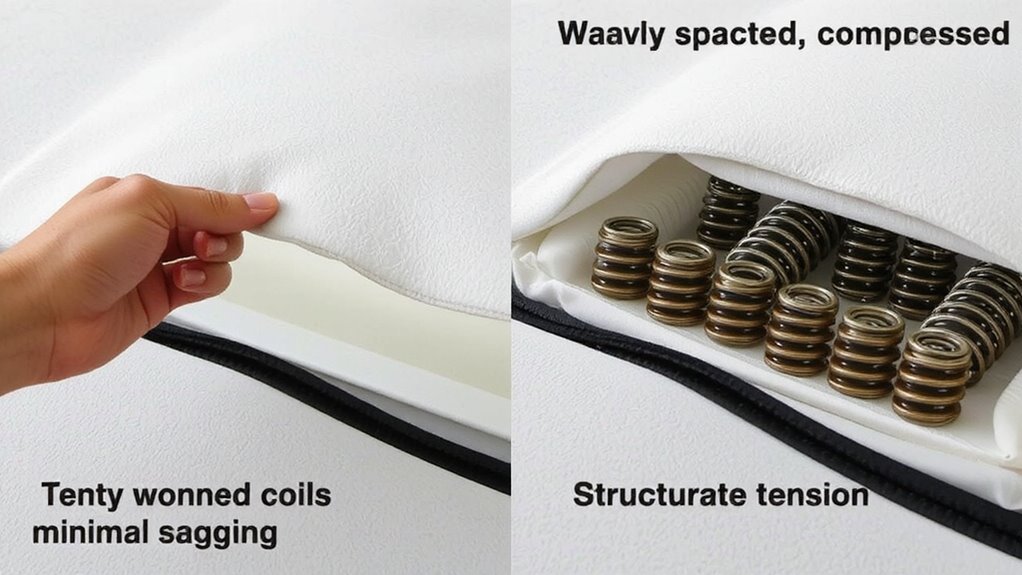
A higher coil count can contribute to a mattress’s durability, but it’s not the only factor you should consider. More coils help distribute weight evenly, reducing wear on individual springs over time. However, the coil material matters just as much-high-quality steel resists sagging better than thinner, weaker metals. If the coils rust or weaken early, even a high count won’t save the mattress. Edge reinforcement also plays a key role; reinforced edges prevent compression around the perimeter, keeping the sleep surface stable and extending its usable life. Without strong edges, sitting or sleeping near the side can lead to faster breakdown. A well-built mattress balances coil count with strong materials and solid edge support. Look for models with both robust coil material and reinforced edges to maximize longevity. Check warranty terms too-many offer 10+ years of coverage when these features are combined.
Coil Gauge and Design: Do They Beat High Count?
How strong are the springs really? It’s not just about how many coils there are, but also their coil gauge and coil design. A lower coil gauge means thicker, sturdier springs, offering firmer support-ideal if you need spine alignment or suffer from back discomfort. Thinner coils, with a higher gauge, tend to feel softer but may wear faster. Meanwhile, coil design-like Bonnell, offset, or pocketed-affects motion isolation and contouring. Pocketed coils, for example, move independently, reducing partner disturbance. You might find that a thoughtful coil design with a moderate count supports you better than a high-count model with weaker construction. Look for models with clear coil specs, trial periods, and solid warranties. These details help you test comfort and durability risk-free, leading to smarter choices for long-term sleep quality.
How Mattress Size Changes the Ideal Coil Count
Choosing the right coil count starts with your mattress size-after all, a Queen won’t need the same number of coils as a Twin or King. Larger sizes spread body weight over more surface area, so they need higher coil density to maintain support. That means coil count isn’t just about total numbers-it’s about how densely the coils are packed for your specific mattress size.
| Mattress Size | Avg. Coil Count | Coil Density |
|---|---|---|
| Twin | 400–600 | Moderate |
| Queen | 800–1,000 | High |
| King | 1,000–1,200 | High |
A Twin might feel firm with fewer coils, but a Queen with the same count would feel loose. Matching coil density to mattress size guarantees even support, which can help reduce pressure points and improve spinal alignment over time-key for restful sleep and managing discomfort.
How Marketers Inflate Coil Count Numbers
Mattress size plays a role in how many coils you actually need, but that number isn’t always what it seems. Marketers often use clever marketing tactics to make their innerspring mattresses appear superior. They might count each coil in connected units like Bonnell or offset coils, inflating the total simply because smaller, less effective coils are added. Some even include non-supportive helper coils around the edges, which don’t contribute meaningfully to comfort or durability. These misleading claims can make it hard to compare models fairly. Just because a mattress advertises 800 coils doesn’t mean it supports your spine better than one with 600 well-placed, sturdier coils. Always check how the coils are built, their gauge, and layout-don’t rely solely on the total number. This helps you make a practical, informed decision based on real performance, not just inflated figures.
What’s the Ideal Coil Count for You?
Why does coil count really matter when you’re shopping for an innerspring mattress? Because it directly affects support, motion isolation, and long-term durability-all key to your sleep quality. But there’s no universal “best” number. Your ideal coil count depends on personal preference, body weight, and sleeping position. Lighter sleepers might prefer 400–600 coils for a balanced feel, while heavier individuals often benefit from 800+ coils for enhanced support and less sagging. Coil gauge and design matter just as much-thicker coils add firmness, while pocketed coils reduce motion transfer. Don’t rely solely on count; test the mattress if possible. Many brands offer sleep trials and warranties, letting you assess comfort and durability over time. Prioritize how the mattress feels over marketing numbers-your comfort and sleep quality should guide the final choice.
On a final note
A higher coil count can improve support and durability, but it’s not the only factor. Thicker coils (lower gauge) and better designs like pocketed coils often matter more. Your mattress size also affects ideal coil numbers-larger beds need more coils for even support. Watch for inflated counts from marketing tricks. Consider construction, trial periods, and warranties to make a smart choice that suits your sleep needs and lasts.