How to Choose an Innerspring Mattress for a Loft Bed
Measure your loft bed frame first to guarantee the mattress fits and leaves enough clearance underneath. Pick a low-profile innerspring, ideally 6 to 8 inches thick, so you have room to sit up and move comfortably. Choose reinforced edges for better support when sitting or stretching. Opt for breathable innersprings with pocketed coils-they reduce motion transfer and stay cooler. These models often handle more weight and last longer. Check the warranty and trial period to confirm durability. You’ll find details that match your needs just ahead.
Notable Insights
- Measure your loft bed frame and ceiling clearance to ensure the mattress fits securely without overhang or risk of contact.
- Choose a low-profile innerspring mattress between 6 to 8 inches thick for adequate headroom and safe under-bed use.
- Prioritize models with reinforced edge support using dense coils or high-density foam to enhance durability and usable sleep surface.
- Select a breathable innerspring design with ventilated coils and moisture-wicking cover to prevent overheating in elevated sleeping space.
- Match coil type and weight capacity to your needs-opt for pocketed coils for motion isolation and higher steel gauge for heavier users.
Measure Your Loft Bed Frame First

Before you start shopping for an innerspring mattress, take a moment to measure your loft bed frame carefully, since size determines which mattresses will fit safely and comfortably. Confirming frame compatibility guarantees the mattress won’t shift or overhang, reducing fall risks and wear. You’ll also need to check the clearance measurement-the space between the slats and ceiling-to avoid tight fits that limit airflow or make bedding changes difficult. Most loft beds need low-profile mattresses, so this step shapes your thickness options early. Accurate measurements help you avoid returns and guarantee proper support for restful sleep. Some innerspring models list compatible frame types and recommended clearances, so compare specs before buying. A good warranty often covers structural issues, which matters when support depends on precise fit. Getting this right improves safety, comfort, and long-term use without disrupting your sleep environment.
Pick the Right Thickness for Your Loft
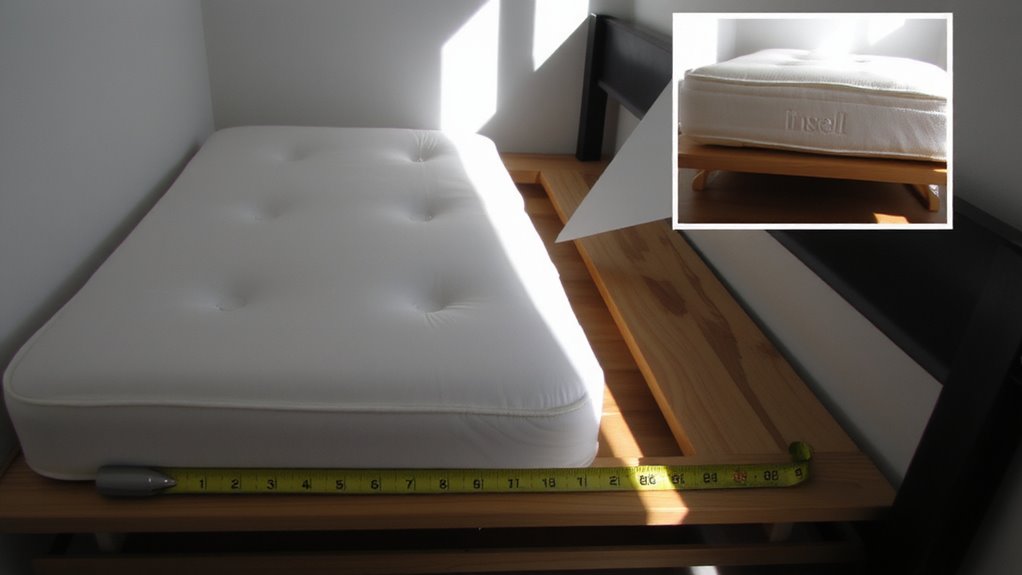
While your loft bed’s height and frame size set the foundation, choosing the right mattress thickness makes a real difference in both comfort and function. You’ll need to account for loft clearance, especially if you’re using the space underneath for sitting, studying, or storage. Most loft beds have height restrictions, so aim for a mattress between 6 to 8 inches thick-enough for support, yet low enough to prevent crowding. A taller mattress might exceed safe rail limits or make climbing up difficult. Innerspring models in this range typically offer firm, stable support ideal for back and stomach sleepers. Check your bed’s manual for exact clearance specs. Remember, your sleep quality depends not just on comfort but on how well the mattress fits the structure. A proper fit helps maintain airflow and reduces the risk of overheating.
Don’t Skip Strong Edge Support

A well-built innerspring mattress for your loft bed should have solid edge support, especially since space is tight and every inch of usable surface matters. You’ll sit on the edge to put on shoes or stretch out while reading, so edge durability is key. Poor support leads to sagging over time, shortening the mattress’s support lifespan. High-quality coils along the perimeter or reinforced foam edges help maintain stability and usable sleep area. When selecting a loft bed, consider models designed with dual-layer coil edge support to ensure maximum durability and comfort.
| Feature | Benefit | Long-Term Value |
|---|---|---|
| Dense perimeter coils | Improved edge durability | Extends support lifespan |
| High-density foam rails | Resists compression | Maintains shape over years |
| Dual-layer coil edge | Stronger sitting edge | Better long-term performance |
Choose models with clear edge support design to get steady performance and lasting comfort from your loft bed setup.
Stay Cool With Breathable Innersprings
You’ve covered the importance of strong edges for everyday use and longevity, and now it’s time to examine how temperature regulation affects your sleep quality in a loft bed setup. Since loft beds can trap heat due to limited airflow around the mattress, choosing an innerspring with smart airflow design is key. The open structure of innerspring coils naturally supports better ventilation compared to solid foam layers, helping heat escape and keeping you cooler. Look for models with breathable fabric covers and layered cushioning that wick moisture without trapping warmth. Good temperature regulation reduces night sweats and helps maintain deep, uninterrupted sleep-especially helpful if you’re prone to overheating. Paired with breathable bedding, these features improve comfort over time. Many quality options include trial periods, so you can test how well the mattress manages heat in your space. For even greater cooling performance, consider models infused with gel mattresses technology to enhance thermal regulation.
Bonnell or Pocketed Coils: Which Is Better?
Why do some innerspring mattresses feel bouncier while others offer more targeted support? It comes down to coil type. Bonnell coils are interconnected, creating a springy feel that’s common in budget models. They offer decent coil durability but transfer motion easily-meaning you’ll feel your partner move. Pocketed coils, on the other hand, are individually wrapped, providing better motion isolation and contouring to your body. This makes them ideal if you share a bed or move often at night. While both types can support healthy spinal alignment, pocketed coils usually offer more personalized comfort and reduced partner disturbance. Coil durability tends to be higher in well-made pocketed systems due to less friction between units. If undisturbed sleep matters to you, especially in a loft bed where space is close, pocketed coils may be worth the extra investment. Check warranty length and trial periods to test performance risk-free.
Choose a Mattress That Handles Your Weight
Most innerspring mattresses are built to support a range of body weights, but not every model handles heavy or lighter frames the same way. If you’re heavier, look for coils with higher gauge steel and firmer support to guarantee proper weight distribution and prevent sinking. Lighter sleepers may find too much firmness uncomfortable, so a balanced hybrid design can offer better pressure relief without sacrificing support. Mattresses with pocketed coils often adjust well to different weights, as they compress individually and reduce motion transfer. Check the manufacturer’s weight recommendations-some brands design models specifically for heavier or lighter users. Consider a model with a trial period and strong warranty, so you can test comfort and support over time. A good innerspring should keep your spine aligned, ease pressure points, and hold up under your weight long-term.
On a final note
Choose an innerspring mattress that fits your loft bed’s dimensions and weight limit, ideally no thicker than 6–8 inches. Pocketed coils offer better motion isolation, while Bonnell coils provide firm, uniform support. Look for reinforced edges to prevent sagging and breathable designs to reduce heat buildup. A solid warranty and trial period let you test comfort and durability. Match coil count and gauge to your body weight for proper support. Prioritize function, safety, and comfort to improve sleep quality.