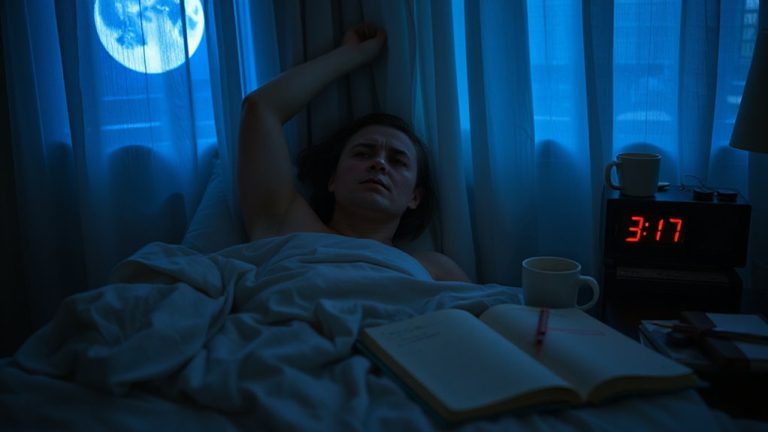
Using Scheduled Light Exposure to Stabilize Sleep in Irregular Sleep-Wake Rhythm Disorder
You can use scheduled light exposure to help reset your sleep pattern if you have irregular sleep-wake rhythm disorder. Sitting in front of a 10,000-lux lightbox for 20–30 minutes soon after waking signals your brain to stay alert and gradually aligns your circadian rhythm. Morning timing, ideally within an hour of waking, strengthens this effect. Choose a device with blue-enriched white light around 470 nm and check for a 30-day trial to test comfort and consistency. There’s more to reflect on about fine-tuning your approach.
Notable Insights
- Scheduled morning light exposure helps retrain the circadian clock in irregular sleep-wake rhythm disorder.
- Using a 10,000 lux lightbox within an hour of waking optimizes circadian realignment.
- Consistent daily timing of light therapy strengthens entrainment to the 24-hour day.
- Light therapy suppresses melatonin and promotes alertness, reducing sleep fragmentation.
- Devices emitting ~470 nm wavelength light are most effective for circadian regulation.
What Is Irregular Sleep-Wake Rhythm Disorder?
What if your sleep pattern felt like it had no pattern at all? You might nap randomly during the day and struggle with sleep at night, lacking a consistent rhythm. That’s irregular sleep-wake rhythm disorder. It’s marked by circadian misalignment-your body’s internal clock doesn’t sync with the 24-hour day. This often leads to sleep fragmentation, where rest is broken into short, unrefreshing chunks across 24 hours. You might get only 1–4 hours at a stretch, no matter how tired you feel. It’s common in people with irregular routines or neurological conditions. Unlike other sleep disorders, there’s no major difficulty falling asleep-just a lack of organization. Diagnosis typically involves sleep logs or actigraphy over a week. Identifying this pattern helps you consider solutions. While not dangerous alone, untreated, it can affect daily performance and well-being. Understanding it is the first step toward better sleep decisions.
Can Light Therapy Help Reset Your Sleep Schedule?
How might you nudge your body’s internal clock back into sync? Light therapy could help, especially if your sleep schedule feels scattered or unpredictable. Your body responds to light intensity, which signals when to feel alert or sleepy. Using a lightbox each morning boosts these cues, supporting better circadian flexibility. You’ll want a device that delivers at least 10,000 lux at a safe distance, with minimal UV output. Consistent timing matters-try 30 minutes soon after waking. Sitting near the light while reading or eating breakfast works well. Results vary, but some notice improvements in 1–2 weeks. Side effects like eye strain are mild and short-lived. No prescription’s needed, and many units come with a 30-day trial or warranty. It’s not a cure-all, but for some, it’s a practical tool to help stabilize sleep when used correctly.
How Light Therapy Reprograms Your Body Clock
Light acts as a powerful cue for your body’s internal clock, shaping when you feel awake or tired each day. When you use light therapy, you’re giving your system clear signals through photic stimulation-light hitting your eyes at key times. This input helps shift your sleep-wake patterns gradually, aligning them more closely with a 24-hour day. Over time, consistent exposure supports circadian entrainment, the natural synchronization of your body’s rhythms to the environment. You don’t need intense light; most devices offer adjustable brightness, typically 10,000 lux, proven effective in clinical settings. Using them daily, especially in the early part of your wake period, strengthens the timing of your internal clock. Many units come with warranties and timers, allowing safe, controlled sessions. Results vary, but improvements in sleep regularity often appear within a few weeks.
Best Times for Morning Light Exposure
You’ll get the most benefit from light therapy when you time your exposure to match your body’s natural rhythms, building on the way light helps reset your internal clock. For most people, morning light exposure within the first hour of waking supports strong circadian entrainment. This early photic input signals your brain to suppress melatonin and boost alertness, helping stabilize your sleep-wake cycle. If you wake at 7 a.m., aim for bright light between 7:00 and 8:00 a.m. Consistency matters-using light at the same time daily improves long-term results. Exposure lasting 20–30 minutes is often effective, though intensity and distance from the source play roles. Morning light works best when it’s part of a daily routine, reinforcing natural rhythms without strain. Over time, this habit strengthens your body’s response to photic input, promoting more reliable sleep patterns.
Choosing a Light Therapy Box: Features That Matter
While not every light therapy box delivers the same results, picking the right one can make a real difference in managing your sleep patterns. Look for solid wavelength accuracy-devices emitting light close to 470 nanometers best support circadian regulation. Avoid units with broad-spectrum or dim output, as they may not provide the right signal strength. A bright, steady 10,000 lux at a comfortable distance is ideal. Device portability matters if you travel or have limited space; compact, lightweight models with no external cords offer more flexibility. Check for sturdy build quality and adjustable brightness to tailor your sessions. Many reliable brands offer a 30-day trial and solid warranty, so you can test effectiveness without risk. Prioritizing these features helps guarantee consistent, usable light exposure that fits your daily routine. For evening use, consider bulbs with reduced blue emission to support melatonin production, such as those labeled as best light bulbs for health.
Overcoming Common Light Therapy Challenges
Why do some people still struggle with sleep even after starting light therapy? It often comes down to timing consistency and device placement. Using your light box at the same time every day helps regulate your internal clock-skipping or shifting sessions can reduce benefits. Place the device about 16–24 inches from your face, slightly off-center, so light reaches your eyes indirectly. Avoid staring directly at the lamp, and keep sessions during early morning unless advised otherwise. For those seeking a gentler alternative, a wake-up light with sunrise simulation can gradually increase light exposure to mimic natural dawn.
| Challenge | Solution |
|---|---|
| Inconsistent use | Set a daily alarm for timing consistency |
| Poor brightness | Choose a 10,000-lux lamp with adjustable tilt |
| Wrong placement | Position at eye level with indirect exposure |
Most units offer a 30-day trial, so test placement and timing to match your routine.
On a final note
You can use scheduled light exposure to help stabilize your sleep if you have irregular sleep-wake rhythm disorder. Morning light therapy, done consistently, may reset your body clock by signaling wakefulness at set times. Choose a light box with 10,000 lux, a diffused screen, and UV filtering. Look for models with timer settings and a stand. Most offer a trial period or warranty, so test one for at least three weeks to see results.