Best Sleep Training Alarm Clocks Kids and Parents Love
You’ll find sleep training alarm clocks that use gentle color cues-red for rest, green for wake-to help your child understand when to stay in bed. Models like LittleHippo Mella and iHoo offer sound options, adjustable night lights, and child locks, with most being corded and some featuring battery backup. They’re made from child-safe materials and meet safety standards, supporting consistent routines. Look for dimming displays, nap timers, and warranty coverage to match your needs. Exploring each model’s features reveals how small differences can make a meaningful impact.
We are supported by our audience. When you purchase through links on our site, we may earn an affiliate commission, at no extra cost for you. Learn more. Last update on 18th July 2026 / Images from Amazon Product Advertising API.
Notable Insights
- Color-coded lights (red, yellow, green) help children understand when to sleep, stay in bed, or wake up easily.
- Customizable sounds and night light colors promote soothing sleep environments and independent morning routines.
- Battery backup preserves settings during power outages, ensuring consistent sleep training overnight.
- Child locks prevent accidental changes, giving parents peace of mind and kids reliable cues.
- Top-rated models combine durable, safe materials with intuitive designs that both kids and parents appreciate.
Ok to Wake Kids Alarm Clock

Is your toddler struggling to stay asleep until a reasonable hour? I’ve found the Ok to Wake Kids Alarm Clock helps by using a simple red-to-green light system that visually signals when it’s time to rise. It’s built with a clear, intuitive button layout, works in 12 or 24-hour formats, and keeps settings intact. You’ll need to plug it in-it doesn’t run on batteries. The night light offers 10 colors and dimming levels, so it’s gentle in a dark room. Made from durable, child-safe materials, it’s easy to use and looks friendly on a shelf. It’s a practical tool that supports consistent sleep training without pressure.
Best For: Families with toddlers or young children who need help understanding when it’s time to wake up and stay in bed.
Pros:
- Uses a visual red-to-green light system to effectively support sleep training and prevent early rising
- Features a customizable night light with 10 colors and 5 brightness levels for a soothing nighttime environment
- Simple, intuitive design with easy programming, 12/24-hour format options, and settings that are preserved during use
Cons:
- Requires constant power supply and must remain plugged in, limiting placement flexibility
- Lacks battery backup, so it won’t function during power outages
- Night light colors, while vibrant, may be too stimulating for some children if not set to lower brightness levels
Ok to Wake Kids Alarm Clock

Could your toddler benefit from a visual cue that makes sense of time? I’ve found the Ok to Wake Kids Alarm Clock helps by using a red light for bedtime and green for wake-up, offering a simple signal that supports consistent routines. Its star-shaped design glows softly, blending into room decor while aiding sleep training. I can customize colors, brightness, and sounds, setting ideal sleep and wake times with five music options. It must stay plugged in, but the intuitive buttons make adjustments easy. The child lock prevents accidental changes, and I appreciate how it encourages independent waking-promoting better rest for both kids and me.
Best For: Toddlers and young children learning to understand bedtime and wake-up time through visual cues, and parents seeking to establish consistent sleep routines.
Pros:
- Uses intuitive red-to-green light system to teach time and reinforce healthy sleep habits
- Customizable colors, brightness, sounds, and music for personalized sleep support
- Star-shaped design with soft glow enhances bedroom decor while aiding sleep training
Cons:
- Must remain plugged in, limiting placement options
- Some features may require adult setup and adjustment
- Music and light options, while customizable, may not suit all children’s preferences
Stay-in-Bed Clock for Kids – Toddler Sleep Trainer, Night Light & Alarm
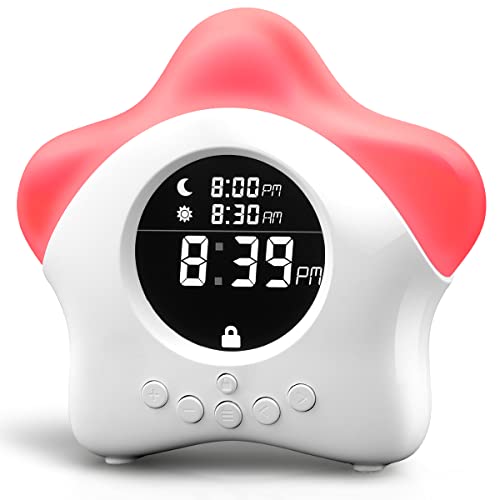
What if your toddler could finally understand when it’s time to stay in bed and when it’s okay to start the day? The Stay-in-Bed Clock uses a simple color system-red, yellow, green-to visually signal sleep and wake times, helping build consistent routines. I rely on its soft LED lights and quiet countdown timer for naps or overnight sleep. It runs on USB power with battery backup, so settings won’t reset during outages. The included storybook, quick start guide, and 8-week reward chart support gentle habit-building. With a nightlight, adjustable sounds, and clear display, it’s functional and easy to use.
Best For: Parents of toddlers and young children looking for a visual sleep training tool to encourage healthy sleep habits and reduce early morning wake-ups.
Pros:
- Uses an intuitive color-coded light system (red, yellow, green) to help toddlers understand when to stay in bed and when it’s time to wake up
- Includes helpful accessories like a storybook, 8-week reward chart, and sleep strategy tips to support consistent bedtime routines
- Features USB power with battery backup, ensuring settings are preserved during power outages
Cons:
- Battery backup requires separate purchase of batteries, which are not included
- Limited color customization beyond the preset sleep/wake indicators
- Sound levels are adjustable but offer only two options, which may not suit all sensitivity needs
OK to Wake Clock for Kids (Blue)
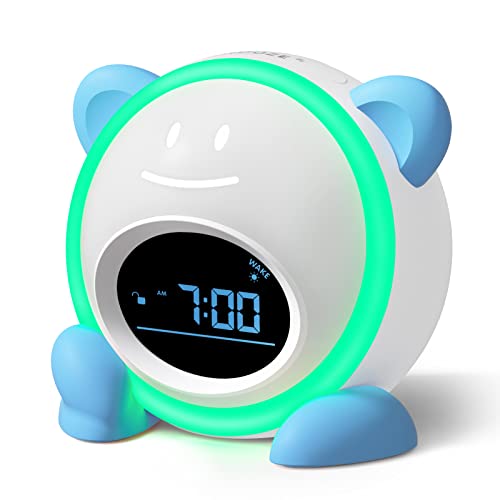
When teaching young children the difference between sleep time and wake time, a visual aid like the Windflyer OK to Wake Clock for Kids (Blue) can make all the difference-especially for families struggling with early risers or inconsistent routines. I’ve found its color cues and animated face clearly signal when to stay in bed or rise, supporting healthy sleep habits. It combines a night light, sound machine, and alarm, all in a durable ABS round design. Powered by AC with a backup battery, it keeps settings during outages. The child lock prevents changes, and at 4.6 by 5.5 inches, it fits snugly on any nightstand. With a 4.4-star rating from over 4,200 reviews and a manufacturer’s warranty, it’s a reliable pick for families testing sleep solutions.
Best For: Families with young children who need help establishing consistent sleep and wake routines using visual cues and multi-functional bedtime support.
Pros:
- Clear color cues and animated expressions help children understand when to sleep or wake up
- Combines a night light, sound machine, alarm, and nap timer in one durable, space-themed design
- Child lock and backup battery preserve settings and prevent tampering during power outages
Cons:
- Requires AC power with no battery-only operation, limiting placement flexibility
- Blue light may be stimulating for some children if used during sleep hours
- Larger size may not fit small nightstands or travel bags easily
LittleHippo Mella Kids Alarm Clock & Sleep Trainer
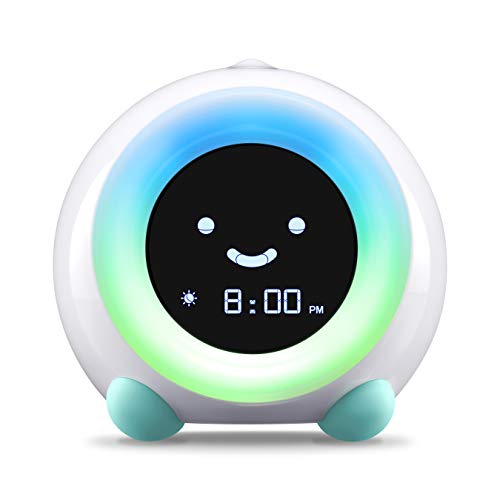
If you’re looking for a sleep trainer that combines visual cues with safety and simplicity, the LittleHippo Mella Kids Alarm Clock stands out for children learning to stay in bed until morning. It uses color changes-yellow before wake time, then green when it’s okay to rise-along with friendly facial expressions to guide kids. MELLA also offers three sleep sounds, five night light colors, and multiple alarm options, including a silent countdown for older children. Made from child-safe ABS and silicone, it meets strict safety standards like FCC, CE, and CPSIA. Backed by a 100% satisfaction guarantee, it’s a reliable choice for families building healthy sleep routines.
Best For: Families with young children learning to stay in bed until morning and needing visual cues to understand sleep and wake times.
Pros:
- Uses intuitive color changes and facial expressions to help kids recognize when it’s time to sleep and wake up
- Features multiple soothing sleep sounds, customizable night light colors, and flexible alarm options for various age groups
- Made from child-safe materials and meets rigorous international safety standards including FCC, CE, and CPSIA
Cons:
- No mention of battery backup in case of power outage, which could disrupt sleep routine
- Limited interactivity or advanced features compared to smart-enabled kids’ clocks
- Some users may find the color transition timing inflexible without customizable dimming or gradual fade options
Dinosaur Kids Alarm Clock with Night Light
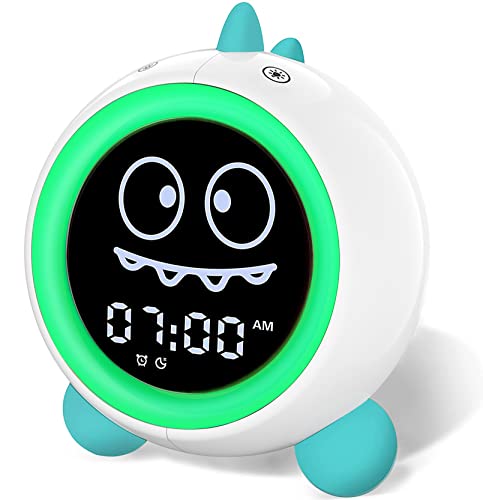
Could a playful dinosaur face help your toddler understand when to stay in bed and when it’s okay to wake up? I’ve found this 5-inch silicone and ABS clock uses color cues and expressive eyes to do just that. It’s dimmable, with a clear digital display, and stays plugged in-no batteries needed. The night light offers 9 colors and 5 brightness levels, doubling as a wake-up light. I can choose from 17 sounds to calm my child, including lullabies and white noise. It has a nap timer, child lock, and earned FCC and RoHS certifications. H-chin backs it with a 1-year warranty.
Best For: Parents seeking a fun, interactive sleep training tool for toddlers that combines visual cues, soothing sounds, and customizable lighting to establish healthy sleep routines.
Pros:
- Engaging dinosaur design with color-changing face and expressive eyes helps toddlers understand sleep and wake times
- Versatile sound and light options including 17 soothing sounds and 9 colored night lights with adjustable brightness
- Durable, safe materials with FCC, CE, and RoHS certifications, plus a child lock and 1-year warranty
Cons:
- Requires constant power connection, limiting placement options without nearby outlets
- Lacks battery backup, so power outages disrupt functionality
- Some features may be too advanced for very young toddlers, requiring parental setup and supervision
Kids Alarm Clock with Sound Machine
I find the Kids Alarm Clock with Sound Machine works best for parents guiding children ages 3 to 12 through sleep training, especially when consistent visual cues and soothing sounds help reinforce bedtime routines. The green sun and red glow clearly signal wake and sleep times, while the 12 calming sounds-like rain, crickets, and lullabies-mask household noise. With 10 volume levels and auto-off timers, it’s easy to customize. A dimmable display and soft LED night light, including red light mode, support healthy sleep cycles. It plugs in, has battery backup, and includes a child lock. I’ve used it to ease bedtime struggles-its design balances function and comfort without distraction.
Best For: Parents helping children ages 3 to 12 develop consistent sleep habits through visual cues and calming sound routines.
Pros:
- Clear green and red visual indicators help toddlers understand when to wake up and when to sleep
- 12 soothing sounds with adjustable volume and auto-off timer enhance sleep quality by blocking background noise
- Soft LED night light with red light mode supports nighttime comfort and healthy sleep cycles
Cons:
- Plug-in only with no built-in rechargeable battery for cord-free use
- Limited alarm chime options may become repetitive over time
- Colorful design may appeal more to younger children, potentially less engaging for older kids
iHoo Toddlers Sleep Training Clock with Night Light

The iHoo Toddlers Sleep Training Clock with Night Light is a solid choice for parents of children ages 2–9 who need help distinguishing when it’s time to sleep or wake up. It uses sun and moon visuals with color cues-green for wake, red for sleep-helping kids follow routines. I like that it has a multi-color night light with warm brightness levels and an auto-dimming display, so it doesn’t disrupt sleep. It plays six calming sounds, like rain or ocean waves, with timers from 30 to 120 minutes. A nap timer and two alarms support daily structure, though alarms aren’t weekday-specific. It’s corded, 5.3 inches wide, and comes with a 12-month warranty, making it a practical, safe pick.
Best For: Parents of children ages 2–9 who want a visual and auditory tool to reinforce healthy sleep routines and reduce early wake-ups.
Pros:
- Clear sun and moon light cues with color indicators (green for wake, red for sleep) help toddlers understand sleep and wake times
- Offers 6 soothing sounds with customizable auto-off timers and a multi-color night light with warm brightness settings
- Includes nap timer, two alarms, and child lock for added functionality and safety
Cons:
- Alarms cannot be set separately for weekdays and weekends, limiting schedule flexibility
- Requires a power cord and is not battery-operated, reducing portability
- Display color is fixed as pink, which may not appeal to all children
Ok to Wake Sleep Training Alarm Clock
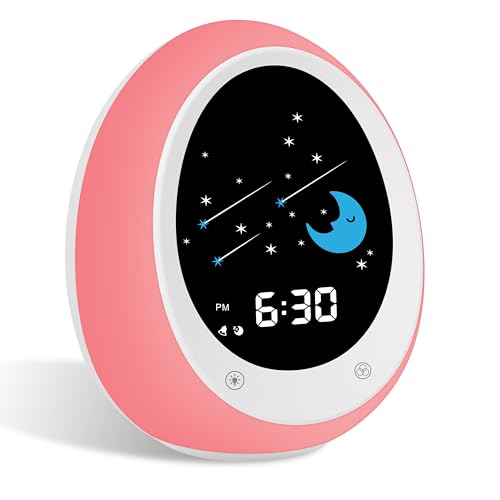
A sleep training alarm clock with an Ok to Wake function works best for toddlers learning to stay in bed until morning, using simple visual cues like a sun or moon to signal when it’s time to rise. I rely on its color indicators-green for go, red for rest-to reinforce a consistent sleep schedule. The nap timer offers 15 to 120-minute options, so I can set brief rests without changing wake-up times. With 17 sounds, including white noise and nature tracks, it masks household noise effectively. Its night light provides soft, tap-adjusted hues that dim automatically. The large display, child lock, and corded design make it practical. I appreciate the memory feature-it saves settings after power loss.
Best For: Toddlers and preschoolers learning to stay in bed and follow a consistent sleep schedule with the help of visual and auditory cues.
Pros:
- Clear color-coded and icon-based Ok to Wake system helps children understand when to stay in bed and when it’s time to get up
- Nap timer with multiple duration options allows flexible napping without disrupting the main wake-up alarm
- 17 soothing sounds and an adjustable night light support calming sleep environments and easy nighttime reassurance
Cons:
- Corded design limits placement options and may require nearby outlet access
- Automatic dimming of night light may be too dark for some children’s preferences
- Tap-adjusted colors lack preset customization for specific night light routines
Ok to Wake Kids Alarm Clock with Night Light

Who wouldn’t want a child’s bedtime and wake-up routine to run smoothly, especially when visual cues make all the difference? I’ve found the Ok to Wake Kids Alarm Clock with Night Light helps by using a green light and flashing sun to signal it’s time to rise, while a red light and moon icon gently show bedtime. It offers 7 soothing sounds and 5 light modes, easing loneliness and supporting independent sleep. The night light glows softly but turns off automatically, reducing dependency. Dual alarms and a 9-minute snooze cycle help prevent oversleeping. Shaped like a cat and made from safe ABS and silicone, it’s durable and appealing.
Best For: Parents seeking an intuitive, visual tool to help toddlers and young children establish consistent sleep and wake-up routines.
Pros:
- Uses color and icon cues (green/sun for wake, red/moon for bed) to clearly communicate sleep times
- Offers 7 soothing sounds and 5 light modes to comfort children and support independent sleep
- Features dual alarms and a 9-minute snooze function for flexible, reliable waking
Cons:
- Limited alarm customization compared to advanced smart clocks or apps
- Cat-shaped design may not appeal to all children’s preferences
- Automatic night light shut-off may be too soon for some kids needing longer illumination
Factors to Consider When Choosing a Sleep Training Alarm Clock
You’ll want to check how the color indicators work, since clear visual cues help your child know when it’s time to wake or stay in bed. Look for a variety of sound options and adjustable brightness levels so you can tailor the clock to your child’s sleep environment and sensitivity. Don’t overlook power source reliability and whether the device has a child lock, both of which add stability and prevent accidental changes during use.
Color Indicators Functionality
While some children respond well to simple audio cues, color indicators offer a visual alternative that can strengthen understanding of sleep routines. You’ll find most clocks use red to signal bedtime and green for wake-up time, giving your child clear, instant feedback. Some models add yellow or orange as intermediate phases-like “prepare to wake” or “nearly time for bed”-to smooth shifts in routine. You can often adjust brightness and hue, ensuring the light stays visible without disrupting sleep onset. Animated color shifts, such as a gradual move from red to green, help reinforce time-based expectations in a way kids grasp easily. Many clocks combine colors with symbols like suns, moons, or stars, reinforcing the meaning of each stage. These features work together to support consistency, especially during early training phases.
Sound Options Variety
What kind of sounds will actually help your child settle and stay asleep? Look for clocks offering up to 17 sound options, including white noise, nature sounds like rain or ocean waves, and gentle lullabies. These varied choices let you match audio to your child’s preferences, improving sleep consistency. Many models include 3 white noise, 4 lullabies, and 10 nature tracks-giving you flexibility to adjust as sleep needs change. You’ll also want volume controls with up to 10 levels so you can set a calming, safe intensity. Most clocks come with auto-off timers between 15 and 120 minutes, helping reduce overnight dependency and save power. The right mix of sound types can mask household noise, supporting deeper sleep. With diverse audio options, you can test what works best for your child’s routine.
Brightness Customization Levels
A good sleep environment balances sound and light to support rest without overstimulation, and just as audio choices matter, so does the brightness of your child’s alarm clock. You’ll find many models offer five adjustable brightness levels, letting you shift from a soft glow to full visibility based on your child’s needs. Some clocks automatically dim at night, reducing blue or white light that can interfere with melatonin and disrupt sleep cycles. Display and night light brightness often adjust separately, giving you precise control in shared rooms or for kids sensitive to light. Lower settings provide a calming presence during bedtime, while higher levels help during nighttime routines without fully waking your child. You can tailor the light to match room conditions or personal tolerance, ensuring the clock supports, rather than hinders, sleep hygiene.
Power Source Reliability
When choosing a sleep training alarm clock, the reliability of its power source plays a key role in maintaining consistent sleep routines. If you rely on a model that only uses external power, you risk losing time and alarm settings during outages, which can disrupt your child’s schedule. To avoid this, look for clocks with built-in battery backup, like a CR2032 coin cell, which keeps settings intact when unplugged. While corded power offers steady performance, it ties placement to outlets. Battery-powered models give you more flexibility but require regular replacements or recharging, increasing the chance of unexpected downtime. The most dependable options combine AC adapters, DC ports, and backup batteries, ensuring continuous operation. These hybrid designs maintain functionality during power interruptions, helping your child’s sleep stay on track without surprise disruptions.
Child Lock Security
Keeping your child’s sleep schedule on track means protecting it from unintended changes, and that’s where a reliable child lock becomes essential. You’ll want a clock that prevents accidental or deliberate adjustments to alarms and light settings, especially during naps or overnight. Look for models requiring a long button press or specific sequence to release-this reduces tampering. A strong child lock keeps customized routines intact, supporting independence while you maintain control. Many clocks also retain settings after power outages, particularly when memory backup is included, so the lock stays effective even after disruptions. This feature saves you from daily reprogramming and guarantees consistency. Choose a device that balances security with ease of use, offering clear instructions for locking and releasing. Testing the lock function during a trial period can confirm it performs well in your routine. A solid warranty adds extra peace of mind.
Frequently Asked Questions
Can I Use the Alarm Clock Overseas With Different Voltage?
You can use the alarm clock overseas if it supports dual voltage, usually labeled 100–240V. Check the back or plug for voltage specs-most modern models handle global voltage, but you’ll still need a plug adapter. If it only reads 110–120V, it won’t work safely abroad without a voltage converter. Always verify input ratings first to avoid damage. Some come with USB power, offering easier compatibility.
Is the Night Light Bright Enough for Nighttime Feeding?
Yes, the night light’s brightness is soft but sufficient for nighttime feeding, designed to help you see without fully waking. You won’t need harsh overhead lights, which helps maintain sleep rhythm. It offers adjustable brightness, so you can lower or increase it based on your needs. The warm hue reduces blue light, supporting melatonin levels. Test it in your room setup-it’s low-glare, but if you need more light, pair it with a dimmed lamp. Most models offer 30-day returns, so try it risk-free.
Are Replacement Parts Available if the Clock Breaks?
Yes, you can usually get replacement parts if the clock breaks-many brands offer them directly or through retailers. Check the manufacturer’s website for availability, as policies vary. Some models have user-replaceable components like batteries or cords, while others might require sending the unit in for service. Look for products with strong warranty support, at least one year, and clear customer service channels to make repairs easier and extend the device’s lifespan reliably.
Do These Clocks Work Without Wi-Fi?
Yes, these clocks work without Wi-Fi, so you’re not stuck if the internet drops. You set them just like regular alarms, and they keep time on their own. Some models offer extra features with Wi-Fi, like weather updates, but core functions don’t need it. They run on battery backup too, so power cuts won’t stop them. Built to last, they’re simple, reliable, and easy to use. Most come with a warranty, letting you test them risk-free.
Can I Silence the Alarm Manually During Vacation?
You can silence the alarm manually anytime, even during vacation, by pressing the mute or snooze button right on the device. Most models don’t require Wi-Fi for this function, so local controls work independently. The physical buttons respond quickly, letting you pause sound without opening an app. Built-in alarms typically support manual override, ensuring flexibility. Check if your model offers a temporary disable option in settings to avoid resetting schedules.