Best Hammock Sleeping Pads for Ultimate Outdoor Comfort
You’ll stay comfortable outdoors with hammock sleeping pads that balance support, warmth, and weight. Models like the KLYMIT Hammock V and ECOTEK Hybern8 use body-conforming designs and synthetic insulation for heat retention, while the TREKOLOGY UL R7 offers a high R-value for cold weather. Lightweight options pack small, ideal for backpacking, and secure-fit features prevent shifting. Durable materials and warranties back their long-term use-explore the full range to match your sleep needs.
We are supported by our audience. When you purchase through links on our site, we may earn an affiliate commission, at no extra cost for you. Learn more. Last update on 19th July 2026 / Images from Amazon Product Advertising API.
Notable Insights
- KLYMIT Hammock V offers 180° insulation and body-mapping support for side, back, and stomach sleepers in hammocks.
- Inflatable pads with rubber corners and silicone dots ensure secure fit and prevent slipping in hammocks or tents.
- AYAMAYA Underquilt provides 20°F–68°F warmth with lightweight 3.04 lb design, ideal for cold-weather hammock camping.
- Hennessy Radiant Double Bubble Pad reflects 97% body heat and fits double-bottomed hammocks with grommet hanging system.
- ECOTEK Hybern8 inflates in under 10 breaths with FlexCell support and 2.5-inch loft for ultralight, comfortable hammock sleep.
KLYMIT Hammock V Sleeping Pad Inflatable

If you’re a backpacker or camper who relies on a hammock for sleep, the KLYMIT Hammock V Sleeping Pad Inflatable is one of the best choices for staying warm and supported through the night. I use it because it delivers 180° insulation, reducing heat loss with synthetic Klymalite in a V-shaped chamber. It pairs well with most hammocks, inflates in 15–20 breaths, and supports side, back, or stomach sleeping. At 35.8 oz, it’s packable into an 11 x 6-inch sack. Durable polyester construction holds up well, and the included repair patch adds peace of mind. Klymit backs it with a limited lifetime warranty, making it a practical, reliable pick for long-term outdoor comfort.
Best For: Backpackers and campers who use hammocks and need a lightweight, insulated sleeping pad for warmth and comfort in outdoor environments.
Pros:
- Provides 180° insulation with synthetic Klymalite to reduce body heat loss in cold conditions
- V-shaped chamber design offers body-mapping support for side, back, and stomach sleepers
- Lightweight and packable at 35.8 oz with a compact 11 x 6-inch packed size, ideal for backpacking
Cons:
- Requires manual inflation (15–20 breaths), which may be inconvenient for some users
- Limited to use with hammocks, reducing versatility compared to flat sleeping pads
- Higher price point than non-insulated or basic pad alternatives
Ultralight Inflatable Camping Air Mattress

I rely on ultralight inflatable camping air mattresses when I need a sleep system that balances minimal weight with real comfort, especially on long backpacking trips where every ounce counts. These pads weigh considerably less than traditional models and pack down small, so they’re easy to carry. They’re built from tear-resistant ripstop nylon, which holds up well on rough terrain. At 73.5 by 21.5 inches, they give enough space for comfortable sleep and cushioning. Inflation and deflation are quick, saving time and effort. I use them for backpacking, camping, and festivals-they deliver steady support and insulation across conditions.
Best For: Backpackers and outdoor enthusiasts who prioritize ultralight gear and compact packability without sacrificing comfort on multi-day trips.
Pros:
- Weighs significantly less than traditional sleeping pads, enhancing portability for backpacking and hiking
- Made from durable, tear-resistant ripstop nylon that withstands rugged outdoor conditions
- Inflates and deflates quickly, minimizing setup and breakdown time in the field
Cons:
- May require occasional re-inflation overnight due to air loss in varying temperatures
- Less insulation than insulated sleeping pads, potentially requiring additional underpadding in cold conditions
- Susceptible to punctures if used on sharp, unprepared terrain without careful ground selection
Inflatable Sleeping Pad for Camping & Backpacking

You’ll find this inflatable sleeping pad works especially well if you’re pairing it with a Travel Birds NomadNest or SkyNest hammock, thanks to rubber rings positioned on diagonal corners that keep the pad securely in place all night. At 73 x 22 inches and just over a pound, it’s compact enough for backpacking but offers enough surface area for comfortable sleep. The 2-inch thickness cushions you on uneven ground, while silicone dots on the bottom reduce slipping. Made from durable 40D nylon with a TPU coating, it resists wear, stays quiet, and provides a reliable thermal barrier. It packs down small, inflates quickly, and balances comfort with portability for hammock and ground use alike.
Best For: Backpackers and hammock campers seeking a lightweight, stable, and comfortable sleeping pad that integrates seamlessly with Travel Birds hammocks.
Pros:
- Lightweight and compact at just 16.23 oz, ideal for backpacking and easy to pack
- Rubber rings and silicone dots provide secure, slip-resistant fit in tents or when paired with NomadNest and SkyNest hammocks
- Durable 40D nylon with TPU coating offers waterproof protection, thermal insulation, and quiet performance
Cons:
- Limited thickness (2 inches) may not provide sufficient cushioning for side sleepers on rocky terrain
- Compatibility with non-Travel Birds hammocks may be limited due to diagonal ring design
- Inflation requires manual effort with no included pump sack or valve adapter
AYAMAYA Hammock Underquilt for Camping & Cold Weather

The AYAMAYA Hammock Underquilt suits backpackers and three-season campers who prioritize consistent warmth and straightforward setup in cool, damp conditions. I use its 300g imitation silk floss insulation to stay warm between 20°F and 68°F, which works well from spring to fall. The 20D ripstop nylon shell has a DWR coating, so it resists moisture and wear, while the 300T polyester lining adds durability. At 3.04 lbs, it’s lightweight enough for backpacking, and it packs down small with the included stuff sack. I attach it quickly using elastic straps, bungee cords, and the two carabiners-no fuss, no gaps, just reliable warmth under my hammock.
Best For: Backpackers and three-season campers seeking lightweight, reliable under-hammock insulation for cool, damp conditions from spring to fall.
Pros:
- Effective 300g insulation provides warmth in temperatures from 20°F to 68°F
- Durable 20D ripstop nylon shell with DWR coating resists moisture and abrasion
- Quick, secure setup with elastic straps, bungee cords, and included carabiners
Cons:
- Not suitable for extreme winter conditions below 20°F
- Slight compression of insulation may reduce loft over time
- Army Green color offers limited visibility in low-light environments
ECOTEK Hybern8 Ultralight Inflatable Sleeping Pad
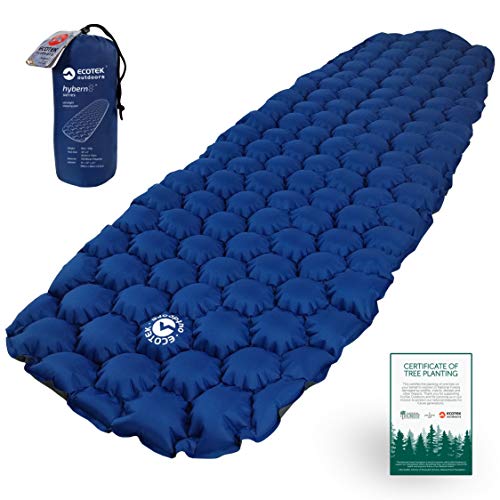
Lightweight and compact, the ECOTEK Hybern8 Ultralight Inflatable Sleeping Pad suits backpackers and hammock campers who value efficient setup and reliable comfort without adding bulk to their pack. I’ve found its one-way valve lets me inflate it in under 10 breaths, and deflation is just as fast. With 2.5 inches of loft and a FlexCell honeycomb design, it molds to my body and the hammock, giving solid support whether I’m on my side or back. The R-value of 2.2 keeps me warm in most three-season conditions. It weighs only 18 ounces and packs small, but the 75D polyester stays tough and comfortable. I trust it on uneven terrain.
Best For: Backpackers and hammock campers seeking a lightweight, compact, and comfortable sleeping pad with quick inflation and reliable 3-season performance.
Pros:
- Rapid inflation and deflation in under 10 breaths thanks to one-way valve design
- 2.5 inches of loft and FlexCell honeycomb structure provide excellent support and comfort in all sleeping positions
- Ultralight at 18 ounces and packs down small, ideal for weight-conscious backpackers
Cons:
- R-value of 2.2 may not be sufficient for cold winter or extreme conditions
- 75D polyester, while durable, may be less puncture-resistant than higher-denier materials
- Inflatable design requires user breath or pump sack, which may be less convenient than self-inflating options
MEETPEAK Inflatable Camping Sleeping Pad

I’ve found the MEETPEAK Inflatable Camping Sleeping Pad works best for backpackers and hammock campers who want a balance of comfort and efficiency without adding bulk to their load. It’s 27.6 inches wide and inflates to 3.2–4 inches thick, offering solid support for side and back sleepers. The V-shape design with an integrated pillow cradles pressure points, while body-mapping tech boosts comfort. I inflate it in 30 seconds by stomping the foot pump-no mouth blowing needed-and it deflates instantly. Made from 40D nylon with TPU coating, it’s lightweight at 1.76 pounds, resists punctures, and packs small. Snap fasteners let me link two pads, and it comes with repair kits, a carry bag, and a one-year warranty.
Best For: Backpackers and hammock campers seeking a lightweight, comfortable, and quickly inflatable sleeping pad with excellent packability and durability.
Pros:
- Inflates in 30 seconds using a foot pump-no mouth or hand inflation needed
- Features integrated pillow, V-shape design, and body-mapping support for enhanced comfort
- Lightweight at 1.76 lbs, packs small, and includes snap fasteners to connect two pads for sharing
Cons:
- May not provide enough cushioning for campers who prefer plush, thick mattresses
- Air release valve must be carefully managed to avoid accidental deflation during use
- No built-in insulation rating specified, which may concern winter campers
Hennessy Hammock Radiant Double Bubble Pad

If you’re camping in cool conditions and need reliable insulation without the bulk, the Hennessy Hammock Radiant Double Bubble Pad fits snugly into your setup, especially if you use a double-bottomed Deep Jungle hammock. I rely on its double-sided silvered polyester to reflect 97% of my body’s heat, and the tapered 67” × 29” × 4.5” design gives shoulder room while saving weight. At just 10 oz, it packs small and works in three-season conditions down to 40°F, especially with a matching sleeping bag. The pad uses a grommet system for secure hanging, and while it’s spot-clean only, its water-resistant surface holds up well. I’ve found it’s a dependable, no-fuss insulation layer, backed by a one-year warranty.
Best For: Campers using double-bottomed hammocks who need lightweight, efficient insulation in cool, three-season conditions.
Pros:
- Reflects 97% of body heat with double-sided silvered polyester for superior warmth
- Lightweight at 10 oz and packs down small for easy transport
- Tapered design and grommet system ensure secure fit and comfort in compatible hammocks
Cons:
- Limited to use primarily with double-bottomed or compatible hammocks for optimal performance
- Spot-clean only care requirement limits maintenance options
- Not rated for sub-40°F conditions without additional insulation
TREKOLOGY Sleeping Pad for Camping (UL R7)

The TREKOLOGY Sleeping Pad for Camping (UL R7) stands out for backpackers who need reliable warmth without the weight, making it a strong match for hikers prioritizing efficiency and comfort in changing conditions. I’ve found its SGS-certified 7.2 R-value keeps me warm on cold ground, thanks to advanced air chambers that trap heat and cushion pressure points. At just 2 lbs and packing down to water-bottle size, it won’t weigh you down. The 4-inch thick 40D ripstop nylon pad inflates quickly through a trusted anti-leak valve, offers solid support up to 330 lbs, and resists tears and moisture, so it lasts season after season.
Best For: Backpackers and outdoor enthusiasts who prioritize lightweight gear, all-season warmth, and reliable comfort in diverse conditions.
Pros:
- SGS-certified 7.2 R-value delivers excellent thermal insulation for year-round use
- Ultralight at 2 lbs and packs down small, ideal for minimizing pack weight and space
- Durable 40D ripstop nylon with TPU coating offers waterproofing, tear resistance, and support up to 330 lbs
Cons:
- Inflation requires manual effort, which may be tiring at high altitudes or after a long hike
- Higher price point compared to basic foam or lower R-value pads
- Anti-leak valve, while reliable, may require careful handling to avoid debris clogging
Ultralight Inflatable Camping Sleeping Mat

You’ll find the Ultralight Inflatable Camping Sleeping Mat especially suited if you value compactness and low weight without surrendering comfort on the trail. I weigh mine often-it’s just 397 grams-and appreciate how it rolls down to 11 x 3.2 inches, fitting easily in my pack. Built from ripstop nylon, it resists tears and handles rugged use. The 73.5-inch length gives me room to sleep well, while the air core cushions and insulates. It inflates fast, packs small, and I’ve used it backpacking, camping, even at festivals. Comes with a carry bag, and I’ve had no issues since it launched in August 2022.
Best For: Backpackers and outdoor enthusiasts who prioritize ultralight gear and compact packing without sacrificing comfort.
Pros:
- Weighs only 397 grams, making it ideal for lightweight backpacking
- Durable ripstop nylon construction resists tears and withstands rugged use
- Quick inflation and deflation with a compact packed size of 11 x 3.2 inches
Cons:
- Air-filled design may offer less insulation in very cold conditions
- Manual inflation required, which can be tiring and time-consuming
- Limited length (73.5 inches) may not suit taller users comfortably
Haven Insulated Pad Cover (Standard/XL)

I rely on the Haven Insulated Pad Cover (Standard/XL) when I need dependable warmth and protection in a hammock setup, especially where cold air under the pad could disrupt rest. It targets Cold Butt Syndrome with layered insulation-moderate at the legs, heavier at the core, and maximum at the mid-section-boosting the pad’s performance by roughly R4. Made by Haven Tents (Model 4397, ASIN: B0CTVS7CSX), it fits their Standard and XL pads and works with air mattresses. The 1.6-pound cover uses quiet, soft, waterproof fabric to guard against punctures and dampness. It also doubles as a pillow, adding versatility.
Best For: Hammock campers and outdoor enthusiasts seeking reliable insulation, moisture protection, and added comfort in cold conditions.
Pros:
- Effectively combats Cold Butt Syndrome with strategically layered insulation (up to R4)
- Doubles as a pillow for added camping convenience and space efficiency
- Waterproof, puncture-resistant fabric enhances durability and comfort in damp environments
Cons:
- Limited to compatibility with Haven Tents’ Standard and XL pads, reducing universal fit
- Slight bulk and 1.6-pound weight may deter ultralight backpackers
- Higher price point compared to basic pad covers without multifunctional use
Factors to Consider When Choosing a Hammock Sleeping Pad
You’ll want to evaluate insulation performance, especially since warmth in a hammock depends on what’s underneath you, not just your sleeping bag. Weight and portability matter if you’re backpacking, but you also can’t ignore how well the pad fits your hammock or how easy it is to inflate and pack up each morning. Thickness affects comfort and support, so balance cushioning with practicality, and check if the brand offers a trial to evaluate it on actual trips.
Insulation Performance
Thermal protection matters most when the night turns cold and your body starts losing heat to the surrounding air. You need a pad with a high R-value-ideally R-4 to R-7-to resist cold ground and keep you warm. Insulated pads use synthetic or down fills to trap heat and slow conductive and convective loss. Look for V-shaped designs; they limit air movement inside the pad and boost warmth by reducing heat dispersion. Some models include reflective surfaces that bounce up to 97% of your radiant body heat back to you. This helps prevent Cold Butt Syndrome, where your lower body chills at contact points. Without proper under-insulation, you’ll wake cold and uncomfortable. A well-insulated pad guarantees heat stays where you need it. Always check construction quality and warranty-good brands let you test under real conditions.
Weight And Portability
Many hammock sleeping pads weigh just 10 to 20 ounces, making lightness a top priority when you’re counting every ounce for long hikes. You’ll want a pad that compresses small-many fit into a space smaller than a 1-liter water bottle-so it won’t take up precious room in your pack. Look for models made with 40D nylon and TPU coatings; they’re lightweight but still tough enough to handle trail wear. Most come with compact stuff sacks that let you clip them easily to your backpack. Some even include foot pumps or efficient inflation systems so you’re not wasting energy blowing air by mouth. These features save time and effort when you’re tired at camp. A lighter, more packable pad means less strain on your body over miles, helping you sleep better without sacrificing endurance. Focus on balanced design-portability shouldn’t mean fragile or fussy. Test what works for your gear setup and comfort needs.
Compatibility With Hammocks
A well-matched sleeping pad makes a real difference in how comfortably and warmly you sleep in a hammock. You need to match the pad’s dimensions to your hammock’s width and length-gaps or overhangs let cold air in and let the pad shift at night. If you’re using a double hammock, choose a pad wider than 25 inches for full coverage. Look for features like rubber rings, snap buttons, or anti-slip materials that keep the pad anchored. A tapered or V-shaped design fits better in the hammock’s curved arc, reducing pressure points and keeping insulation effective. Make sure the pad inflates to at least 2–4 inches thick so it contours properly. Always check whether the model is made specifically for hammock use-many standard pads don’t perform as well when suspended.
Thickness And Comfort
You’ll want at least 2.5 inches of thickness if you sleep on your side, since that extra loft cushions your hips and shoulders, reducing pressure points and helping you stay comfortable through the night. Most pads range from 2 to 4.5 inches thick, with thicker models offering better cushioning and less contact with cold or uneven surfaces. Some feature contoured or tapered shapes that match your body’s natural curve, improving support. Keep in mind, though, that more thickness usually means added bulk and weight in your pack-something to balance if you prioritize portability. Pads with insulated air chambers or layered construction deliver plush comfort while boosting warmth, so you’re not just cushioned but insulated too. Test different profiles to see what aligns with your sleep habits, and check warranty options for long-term confidence.
Inflation Ease
Under 10 breaths might be all it takes to inflate some lightweight pads, thanks to efficient one-way valve systems that direct airflow smoothly and cut down on effort. If you prefer not to use your mouth, foot-pump designs let you fully inflate the pad in about 30 seconds by stomping on a built-in chamber. Anti-leak valves help maintain pressure while you sleep and speed up inflation by stopping air from flowing back out. Larger pads may take 15 to 20 breaths, depending on chamber size and valve performance. When it’s time to pack up, large open-and-release valves let air escape in seconds, making breakdown quick. Consider how much effort you’re willing to put in during setup and whether speed or compactness matters more. Easier inflation often means slightly more weight, so balance convenience with portability based on your needs.
Durability And Materials
When choosing a hammock sleeping pad, pay close attention to the materials and construction, since these determine how well it holds up over time. Look for ripstop nylon or polyester fabrics coated with TPU-they resist tears, punctures, and moisture. Higher denier fabrics, like 40D or 75D, offer better durability without adding excess weight. Reinforced seams and thermoformed sealing help prevent air leaks and stand up to rough use. Waterproof coatings and tough outer layers keep the pad reliable in wet or rugged conditions. Pay special attention to high-stress areas: valves and edges often wear fastest, so reinforced zones there improve longevity. These features mean the pad can handle repeated packing, unpacking, and trail use. A well-built pad might cost more upfront, but lasts longer and performs better under stress-worth considering when planning extended trips or frequent outdoor sleep.
Size And Fit
A good fit starts with the right dimensions, so check the pad’s length, width, and thickness before you commit. You’ll want a pad between 70 and 78 inches long to match your height and avoid cold spots at your head or feet. Widths range from 21.5 to 47 inches-wider pads offer more comfort, but make sure they fit your hammock’s shape, especially if it’s narrow or tapered. Thickness varies from 2 to 4.5 inches; thicker pads cushion better and insulate more but may reduce stability in snug setups. When packed, some pads compress to as small as 4.5 x 23 inches, so confirm the size fits your pack. Look for pads with rubber rings or snap fasteners that attach securely to your hammock’s structure-this keeps the pad from shifting while you sleep. Check compatibility and test the fit when possible.
Frequently Asked Questions
Can I Use a Sleeping Pad in Rainy Conditions?
Yes, you can use a sleeping pad in rainy conditions, but you’ll need one made with water-resistant or waterproof materials like coated nylon or welded seams. Self-inflating or closed-cell foam pads handle moisture better than open-cell types. Tuck it fully inside your hammock’s rain tarp coverage to stay dry. Check if the pad has a reliable warranty for damp use, and always test it before relying on it in heavy rain.
How Do I Prevent Condensation Under My Hammock?
You prevent condensation under your hammock by ensuring proper ventilation, so you don’t trap warm, moist air against cool surfaces. Use a breathable underquilt or insulated tarp above to manage temperature. Choose a hammock with mesh panels for airflow. Avoid sealing the underside completely with non-breathable pads. Test gear in humid conditions, and check warranties covering moisture-related performance. Adjustable systems let you fine-tune insulation and breathability based on weather.
Are Inflatable Pads Safe for Bear-Prone Areas?
Yes, inflatable pads are safe in bear-prone areas as long as you don’t carry food-scented gear. Bears react to smells, not the pad itself. Most inflatables are made of durable nylon with TPU or PVC coatings, which don’t emit odors. Pair them with a no-scent sleep system, store food properly, and use a bear canister. Many brands offer trial periods, so test one before committing.
Can I Share a Sleeping Pad With a Partner?
you can share a sleeping pad with a partner, but it’s often impractical due to limited space and reduced insulation. most pads aren’t wide enough for two, and sharing may compromise warmth and comfort. instead, use two separate pads designed for side sleepers or twin-sized models that fit side-by-side. check pad dimensions, r-value, and inflation limits. some brands offer pairing options or shared warranty trials, letting you test compatibility before committing.
Do Hammock Pads Work in Snowy Environments?
Yes, hammock pads can work in snowy environments, but you need one with high R-value insulation, typically 4.0 or higher. Cold air circulates under and around you, so rely on synthetic or down-filled pads that resist moisture and retain heat. Pair them with insulated underquilts for best results. Most pads aren’t rated for extreme cold alone, so test in milder winter conditions first and check manufacturer warranty for temperature limitations.