Innerspring Mattress Trial Periods: What to Test During 100 Nights
Test your innerspring mattress fully over 100 nights to check how it supports your spine and sleep habits. Sit on the edges daily to gauge stability and firmness. By night 15, note if hip or shoulder pain improves with proper alignment and cushioning. Around week 4, see if you’re still overheating, which could point to poor cover breathability. Monitor motion transfer during partner movement and inspect for sagging after 60 nights. Consistent performance helps you make a confident, informed choice that aligns with your long-term sleep needs.
Notable Insights
- Test edge support by sitting nightly to assess firmness, stability, and consistency over 100 nights.
- Evaluate shoulder and hip pain reduction by night 15 to gauge spinal alignment and pressure relief.
- Monitor temperature regulation weekly, especially by week 4, to detect heat retention issues.
- Assess motion transfer frequency and intensity when your partner moves during sleep.
- Check for sagging in hip, shoulder, and center areas by night 60 to ensure long-term durability.
Why 100 Nights Matter for Innerspring Mattresses

A 100-night trial gives you enough time to truly assess how well an innerspring mattress supports your body and aligns with your sleep habits. You need several weeks to adjust, especially during the break in period, when the coils and comfort layers settle into your preferred firmness. This adjustment phase is normal and can take up to 30 nights. Only after this do you begin experiencing the true long term comfort the mattress offers. You’ll notice how well it handles pressure points, spine alignment, and motion transfer over time. Since innerspring units often feel firmer at first, patience helps you make a fair evaluation. Use the full trial to test different sleep positions and monitor changes in sleep quality. This duration lets you decide based on real, consistent performance-not just first impressions. Top-rated brands often include free returns and trial period details as part of their customer-friendly policies.
Test Edge Support Every Time You Sit Down
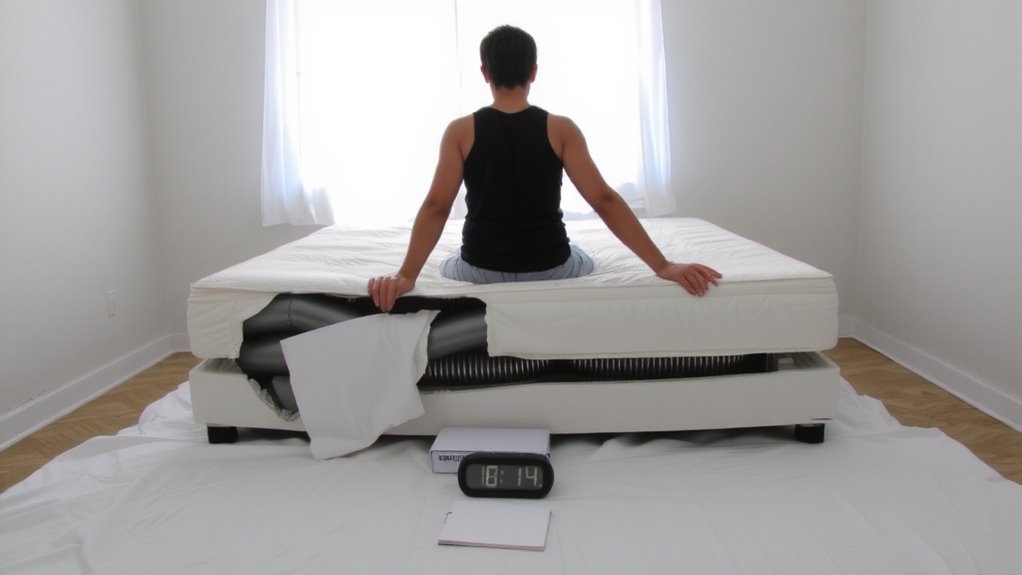
You’ll often sit on the edge of your mattress when putting on socks or tying shoes, so treat each time as a quick chance to assess edge support. Pay attention to edge firmness and sitting balance-both affect durability and usable surface area. A strong perimeter should resist sinking and keep your posture stable. During your 100-night trial, note how consistent support feels over time.
| Test Action | Edge Firmness Level | Sitting Balance Result |
|---|---|---|
| Light perch (10 sec) | Soft / Firm / Solid | Wobbly / Even / Stable |
| Full weight transfer | Soft / Firm / Solid | Leaning / Centered |
| Side-to-side shift | Soft / Firm / Solid | Strained / Smooth |
| Partner edge sit | Soft / Firm / Solid | Tip-prone / Balanced |
| Morning/evening test | Soft / Firm / Solid | Variable / Consistent |
Check If Shoulder and Hip Pain Fades by Night 15

Is your new mattress really easing pressure where it matters most? By night 15, pay close attention to any lingering shoulder or hip discomfort. Proper shoulder alignment and reduced hip pressure are key signs of a supportive innerspring design. If you sleep on your side, your shoulders and hips should sink slightly while staying aligned with your spine. Look for even support-no sinking too deep or feeling overly rigid. Many innerspring models use zoned coils to target hip pressure, while cushioned comfort layers help with shoulder alignment. If pain hasn’t lessened by now, the mattress may lack enough contouring. Trial periods let you test this without risk. Use this checkpoint to assess whether the feel matches your body’s needs, especially if you’ve had past joint soreness. Adjust sleep position or consider a topper if needed, but track changes closely by week three. A well-chosen mattress can make a significant difference for those seeking back pain relief.
Notice If You’re Still Waking Up Hot by Week 4
Why do some innerspring mattresses still leave you waking up hot by week four, despite their reputation for breathability? Even with open coil systems, certain models trap heat due to dense comfort layers or poor cover materials. By now, you should notice if heat retention is an ongoing issue. Check whether your mattress supports proper temperature regulation-this means you stay within a comfortable range all night. Memory foam overlays, while cushioning, often increase warmth. Look for phase-change materials or breathable textiles in the quilted top. If you’re consistently waking up too warm, it may signal inadequate ventilation or a mismatch in your sleep environment. Consider using moisture-wicking sheets or a cooling pad. Don’t assume breathability is guaranteed; test performance over time. Poor temperature regulation can disrupt deep sleep cycles. Use these insights during your trial to assess if adjustments-or a switch-might support better rest. Upgrading to a cooling mattress topper can significantly improve thermal comfort for hot sleepers.
See How Motion Transfer Affects Your Partner
A noticeable shift in sleep quality can occur when one partner feels every roll and turn of the other, and innerspring mattresses vary widely in how they handle motion transfer. If your mattress transmits too much movement, you’re likely to experience partner disturbances, even if your significant other is a light mover. Over the first few weeks, pay attention to how often you wake during the night when your partner shifts or gets up-these sleep disruptions can add up. Coils that are tightly connected, like in traditional Bonnell or offset designs, tend to transfer more motion than wrapped coil systems, which isolate movement better. Testing this during your trial helps determine whether the mattress supports shared rest. Not all innersprings offer the same isolation, so use your 100-night window to judge real-life performance. Few warranties cover dissatisfaction with motion transfer, so evaluate it early.
Check for Sagging or Support Loss After 60 Nights
By the 60-night mark, you’ve had enough time to notice any early signs of sagging or loss of support in your innerspring mattress, especially in high-pressure areas like the hips and shoulders. Check for dips or uneven contours forming where you sleep most. These could indicate issues with coil integrity or frame durability over time. Consistent support matters for spinal alignment and comfort, especially if you have a sleep disorder like chronic back pain. Use this phase to assess how well the mattress maintains its shape and support.
| Area Checked | What to Look For | Why It Matters |
|---|---|---|
| Hip region | Visible sagging or soft spots | Affects spinal alignment |
| Shoulder zone | Uneven compression | May disrupt side-sleeping comfort |
| Center third | Loss of firmness or sinking | Signals coil integrity decline |
| Frame edges | Weakness or collapse when sitting | Reflects frame durability and edge support |
On a final note
You’ve tested edge support, pain relief, heat retention, motion transfer, and durability over 100 nights-key for judging innerspring performance. These mattresses rely on coils for support, so check for sagging and consistent comfort. If shoulder or hip pain persists, or heat builds by week four, consider hybrid options. Use trial data to assess long-term fit. Most warranties cover structural flaws, but not comfort preferences-know the policy. Your sleep quality and partner’s needs should guide the final choice.