How Daily 15-Minute Balance Exercises Improve Sleep Stability
Daily 15-minute balance exercises boost sleep stability by sharpening your body’s internal signals-your inner ear, muscles, and joints communicate more clearly with your brain, helping you feel grounded. Simple moves like standing on one leg or heel-to-toe walks fine-tune coordination and lower physical tension. Paired with mindful breathing, they calm your nervous system, easing the shift into rest. Consistent use supports better sleep onset and continuity, offering a drug-free way to improve rest-there’s more to discover about how this fits into your nightly routine.
Notable Insights
- Balance exercises enhance vestibular and proprioceptive integration, improving body awareness and promoting restful sleep onset.
- Daily 15-minute routines stabilize inner ear and nervous system communication, supporting deeper physical relaxation.
- Mindful breathing combined with balance movements activates the parasympathetic nervous system to ease sleep transition.
- Gentle evening balance poses reduce muscle tension and quiet mental chatter, preparing the body for sleep.
- Consistent practice improves sleep stability by reinforcing circadian patterns without requiring special equipment or time.
Why Balance Exercises Improve Sleep
Ever wonder why something as simple as standing on one foot might help you sleep better? It’s because balance exercises support vestibular integration, helping your brain process spatial orientation more smoothly. When your inner ear and nervous system communicate clearly, your body feels more grounded, reducing nighttime restlessness. These movements also sharpen proprioceptive feedback-your sense of body position-so your muscles and joints send clearer signals to your brain. This improved internal communication promotes physical awareness, which can ease shifts into rest. You don’t need special equipment; just 15 minutes daily on a flat surface works. Many find they fall asleep faster and wake less often. Though results vary, trying balance exercises is low-risk, with some brands offering 30-day trial mats. It’s a drug-free option worth considering alongside other sleep strategies, especially if movement feels unstable during the day.
Calm Your Nervous System in 15 Minutes
You already know that improving body awareness through balance exercises can support better sleep, and now you can build on that foundation by directly calming your nervous system in just 15 minutes. Start with mindful breathing: inhale slowly through your nose for four counts, hold for four, then exhale through your mouth. This simple rhythm signals your body to shift into rest mode. Pair it with gentle stretching-focus on your neck, shoulders, and hips-to release built-up tension. These movements don’t require intensity; even small ranges of motion help quiet stress signals. Perform them in a quiet space, free from screens or distractions. Over time, this routine may improve your ability to shift into sleep naturally. It’s not a substitute for medical treatment, but it can complement other strategies. Think of it as maintenance-like charging a battery before bedtime. With consistent use, you might find you rely less on sleep aids.
Try These 5 Evening Balance Moves
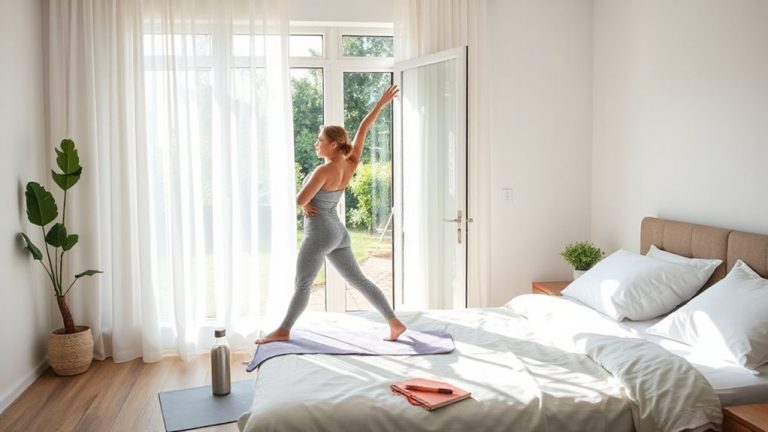
While your body winds down each evening, integrating balance exercises into your routine can support both stability and sleep quality. Try these five simple moves: stand on one leg for 30 seconds, then switch; do a heel-to-toe walk across the room; hold a tree pose from yoga poses for balance and focus; practice a gentle warrior III; finish with a seated forward bend. Each movement encourages muscle relaxation and mental calm. Perform them barefoot on a nonslip surface, using a wall for support if needed. These exercises take about 15 minutes total and require no equipment. You may notice improved coordination and reduced nighttime restlessness over time. They’re safe for most adults, but if you have a balance disorder or mobility issue, consult a healthcare provider. Consistency matters more than intensity-gentle daily practice supports long-term benefits without strain.
Pair Balance With Your Nightly Routine
Incorporating balance exercises into your existing nighttime routine can enhance both physical control and sleep readiness without adding extra time to your evening. Try doing gentle stretching while brushing your teeth, then shift into a simple balance pose like standing on one foot. Follow with two minutes of mindful breathing-inhale slowly through your nose, exhale through your mouth-to signal your body it’s time to wind down. These moves help ease muscle tension and quiet mental chatter. Since sleep quality often reflects daily habits, pairing balance work with mindful breathing supports natural relaxation. This method requires no equipment, minimizing barriers to consistency. You’re not replacing your routine, just upgrading parts of it. Over time, these small changes may reduce reliance on sleep aids by improving sleep onset and stability. There’s no trial period needed-just daily practice.
Build a Daily Habit for Better Sleep
Once balance and mindful movement become a regular part of your evening, building a full daily habit for better sleep starts with small, consistent choices that add up over time. You don’t need dramatic changes-just five to ten minutes daily can initiate a mindset shift that redefines how you view rest and recovery. Track your progress with a consistency tracker, whether a simple calendar checkmark or a sleep app feature, to reinforce commitment and reveal patterns. This tool helps highlight what works, offering objective feedback on how balance exercises influence sleep quality. Over time, you’ll notice improvements in how quickly you fall asleep and stay asleep. If issues persist, consider discussing sleep disorders with a provider, but often, non-drug methods like movement offer meaningful relief. The key is regular practice-like a warranty for better rest, backed by steady use.
On a final note
You can improve sleep stability with just 15 minutes of daily balance exercises. These moves calm your nervous system, support natural sleep rhythms, and work alongside routines without replacing medical treatments. They’re simple to do, require no equipment, and studies suggest consistent practice enhances nighttime rest. Try them for a few weeks-adjust based on how you feel. If sleep issues continue, consult a provider to review options, from behavioral changes to approved aids.