Best Sleep-Friendly Lighting to Calm Your Mind and Bedroom
You’ll want warm amber lights between 1600K and 2200K to reduce blue light and support melatonin production, helping calm your mind for sleep. Look for dimmable models with stepless controls or preset sleep modes that gradually lower brightness. Choose plug-in or USB-rechargeable designs with flicker-free, BPA-free construction for safety and comfort. Motion sensors or dusk-to-dawn operation add convenience while conserving energy. Many top options block over 99.9% of blue light and offer flexible placement-discover which features align best with your nightly routine.
We are supported by our audience. When you purchase through links on our site, we may earn an affiliate commission, at no extra cost for you. Learn more. Last update on 17th June 2026 / Images from Amazon Product Advertising API.
Notable Insights
- Choose warm-colored lights between 1600K and 2200K to minimize blue light and support melatonin production.
- Opt for bulbs with less than 0.1% blue content to reduce retinal stimulation and promote faster sleep onset.
- Use dimmable or stepless dimming lights with 40–100 lumens for ideal nighttime illumination and relaxation.
- Select motion-activated or dusk-to-dawn sensors to enable automatic, energy-efficient lighting without disruption.
- Prioritize flicker-free, BPA-free, and flame-retardant designs for safe, non-toxic, and glare-free sleep-friendly lighting.
2 Pack Amber Night Light Dimmable LED

If you’re looking for a low-light solution that supports nighttime calm without disrupting sleep, the Pack Amber Night Light Dimmable LED offers a practical choice, especially for parents and light-sensitive individuals. I use it in my hallway and nursery because the warm amber glow doesn’t interfere with melatonin. The touch switch cycles through three brightness levels, and the diffused light eliminates harsh glare. It automatically turns on at dusk, guiding safe movement at night. Made from flame-retardant ABS with low heat output, it’s safe for 24/7 use. At just 0.5W, it sips energy, and the slim design keeps a second outlet free. I’ve had mine for months-no flickering, no issues.
Best For: Parents, children, and light-sensitive individuals seeking a safe, warm, and energy-efficient nighttime lighting solution that supports melatonin production and provides hands-free illumination.
Pros:
- Touch-sensitive switch with 3 brightness levels offers customizable ambient lighting
- Dusk-to-dawn sensor enables automatic operation for convenience and safety
- Slim design preserves access to the second outlet while using minimal energy (0.5W)
Cons:
- Not water-resistant, limiting use to indoor environments only
- Amber light may be less appealing to users preferring brighter or cooler tones
- Plug-in design may not suit all outlet configurations or floor-level placements
THAUSDAS Dimmable Touch Night Light

I find the THAUSDAS Dimmable Touch Night Light especially well-suited for light-sensitive sleepers or parents needing low, non-disruptive illumination during nighttime routines, since its flicker-free, dimmable LED minimizes sleep interference. I appreciate its 5 brightness levels and 256 color options, which let me adjust the mood for relaxation or bedtime. The 3-watt LED stays gentle on the eyes, and the 360-degree touch control is intuitive. It’s cordless, USB-rechargeable, and portable-handy during outages or in nurseries. Though not waterproof, its indoor use is practical. With a 12-month guarantee and lifetime support, it’s a reliable pick I’d consider for flexible, calming light.
Best For: Light-sensitive individuals, new parents, and anyone seeking a portable, calming bedside light with customizable brightness and color options.
Pros:
- Flicker-free, dimmable LED with 5 brightness levels and 256 color combinations for personalized, eye-friendly lighting
- Cordless, USB-rechargeable design makes it portable and practical for nurseries, travel, or power outages
- Intuitive 360-degree touch control and remote operation with timer function for added convenience
Cons:
- Not waterproof, limiting use to indoor environments only
- Battery life is not specified, which may affect long-term usability between charges
- Limited color temperature range due to RGB focus, potentially less ideal for task lighting
Sleep Light Bulbs Amber 1900K 2 Pack

These amber sleep light bulbs, glowing like warm candlelight at 1900K, are best for people who want to reduce evening blue light exposure and support their body’s natural sleep rhythm. I’ve found they’re 99.9% free of blue light, which helps boost melatonin and improve sleep quality. They give off 750 lumens of soft, flicker-free light that won’t strain your eyes, even during late reading. With a standard E26 base, they fit most lamps and work well in bedrooms or nurseries. Using energy-efficient LED tech, they deliver 60W brightness while using less power. I think they’re a practical upgrade for calming nighttime lighting.
Best For: People seeking warm, blue light-free lighting to support natural sleep patterns and enhance nighttime relaxation.
Pros:
- Emits 1900K amber light, 99.9% free of blue spectrum, promoting melatonin production and better sleep quality
- Provides 750 lumens of flicker-free, glare-free illumination for comfortable, eye-friendly evening use
- Energy-efficient LED with 60W equivalent brightness and standard E26 base for wide fixture compatibility
Cons:
- Amber light may be too dim or warm for users preferring brighter or cooler lighting for evening activities
- Not suitable for spaces where task lighting with higher color temperature is required
- Limited aesthetic appeal for those who dislike the orange-toned ambiance in modern decor settings
Amber Sleep Light Bulbs 1600K (4-Pack)
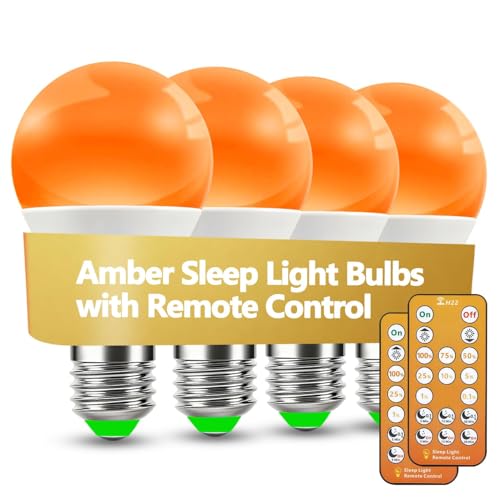
The Wivety Amber Sleep Light Bulbs 1600K (4-Pack) are ideal for anyone seeking a lighting solution that supports natural sleep patterns, especially if you’re sensitive to blue light or establishing bedtime routines for children. I use these bulbs in my bedroom and kids’ rooms because they emit a warm 1600K amber glow with nearly no blue light-just 0.04%-which helps protect melatonin production. They’re flicker-free and dimmable from 0.1% to 100% via remote, so I can adjust brightness for calm evenings. Six preset sleep modes gradually lower light to ease us into rest. At 800 lumens, they’re bright enough for reading but gentle on the eyes. I appreciate their E26 base fits standard lamps, and since they use LED efficiency, they draw less power than a 53W incandescent. I’ve noticed fewer nighttime awakenings since switching.
Best For: Individuals seeking a blue light–free, dimmable lighting solution to support healthy sleep patterns, especially those sensitive to light, parents establishing bedtime routines, or anyone optimizing their nighttime environment for melatonin production.
Pros:
- Emits ultra-low blue light (only 0.04%) and blocks green wavelengths to support natural melatonin release and circadian rhythm regulation
- Flicker-free operation with remote-controlled dimming from 0.1% to 100% and six preset sleep modes for personalized wind-down routines
- 1600K amber light is the lowest color temperature available in LED A19 bulbs, ideal for nighttime use in bedrooms, nurseries, and children’s rooms
Cons:
- Limited to indoor use with standard E26 sockets, not suitable for outdoor or specialty fixtures
- Requires a remote for dimming and mode control-no built-in manual controls or smart home integration
- Lower brightness (800 lumens) may be insufficient for tasks requiring high illumination despite being adequate for ambient or bedtime use
L LOHAS Amber LED Night Lights (2-Pack)

Who wouldn’t want a light that knows when to turn on and off without lifting a finger? I rely on the L LOHAS Amber LED Night Lights to do just that. Their built-in dusk-to-dawn sensor kicks in at night, glowing at a soft 40 lumens with a 2000K amber hue-perfect for soothing, sleep-friendly visibility. They draw only 0.3W, adjust brightness automatically, and stay cool, making them safe around kids and hallways. The slim design doesn’t block nearby outlets, fits standard U.S. plugs, and needs no batteries. I use them in the nursery and bathroom-they’re practical, efficient, and help maintain nighttime calm.
Best For: Families and individuals seeking safe, energy-efficient, and automatic nighttime lighting for hallways, nurseries, bathrooms, and bedrooms.
Pros:
- Automatically turns on at dusk and off at dawn with no manual input required
- Emits a warm, sleep-friendly 2000K amber light that’s gentle on the eyes
- Compact design doesn’t block adjacent wall outlets and requires no batteries
Cons:
- Limited to 110–130V AC outlets, not suitable for international use without adapters
- Amber light color may not appeal to users preferring brighter or cooler tones
- Only two units per pack, which may not be sufficient for larger homes
Hifree Smart Table Lamp RGB Dimmable
I’ve found the Hifree Smart Table Lamp RGB Dimmable works especially well for people who want to manage their sleep environment without replacing their entire lighting setup. It connects to Alexa and Google Assistant, plus the Smart Life app, so you can adjust brightness, color, and timing easily. With 400 lumens and a warm 2700K range, it offers soft, flicker-free light that’s easy on the eyes. The lamp runs on a 7-watt LED that lasts over 10,000 hours, and its anti-blue light feature helps reduce strain. You can set schedules or use one of eight scene modes, like bedtime or reading.
Best For: People seeking an easy-to-use, smart, and eye-friendly table lamp for creating customizable lighting environments, especially for sleep, relaxation, and ambient mood settings.
Pros:
- Supports voice, app, and touch control with compatibility for Alexa, Google Assistant, and Smart Life app
- Offers flicker-free, anti-blue light illumination with 8 preset scene modes and scheduling for better sleep hygiene
- Energy-efficient 7-watt LED with 400 lumens and a lifespan over 10,000 hours, ideal for long-term use
Cons:
- Not water-resistant and limited to indoor use only
- Requires 110V AC power and does not support battery operation
- Limited brightness for larger rooms, best suited for small to medium spaces
2 Pack Very Dim Warm LED Night Lights

Though some night lights flood rooms with harsh glare, I find these dim warm LED models work best for kids and adults sensitive to light during sleep. Positioned at the rear, the soft glow minimizes disruption, supporting healthier rest. I appreciate the three color settings-warm, natural, and cold white-and the touch-sensitive brightness control, which lets me adjust based on need. They turn on at dusk and off at dawn automatically, so I never have to remember. Built with fire-resistant V-0 material and over-current protection, they feel safe to leave plugged in. The pack includes two, backed by a 24-month warranty and lifetime support.
Best For: Individuals and families seeking a sleep-friendly, energy-efficient LED night light with adjustable brightness and color settings for children or adults sensitive to light.
Pros:
- Features a rear-positioned, dim warm LED that minimizes sleep disruption and supports healthy sleep cycles
- Offers three color temperature options and touch-controlled brightness for customizable lighting needs
- Automatically turns on at dusk and off at dawn with built-in light sensor for hands-free, continuous operation
Cons:
- Limited to plug-in use, which may restrict placement in rooms without nearby outlets
- Soft glow may be too dim for users needing more illumination for nighttime visibility
- Color options may be unnecessary for users who prefer a simple, single-color night light
L LOHAS Amber Dimmable Night Light (2 Pack)

The L LOHAS Amber Dimmable Night Light (2 Pack) works best for people looking to support healthy sleep cycles without sacrificing ambient convenience. I rely on its warm 2000K amber glow because it cuts out blue light, helping keep melatonin levels steady. It dims smoothly from 0–100 lumens, so I can tailor the brightness without straining my eyes. The dusk-to-dawn sensor turns it on automatically, and the upward-downward light spread gives soft, even illumination. It’s lightweight, plugs in directly, and works in my bedroom or hallway. Since it’s not waterproof, I keep it indoors. The two-pack offers good value, and its energy-efficient design means I’m not wasting power.
Best For: People seeking a warm, dimmable amber night light that supports sleep quality by eliminating blue light and offering automatic dusk-to-dawn operation.
Pros:
- Emits blue-light-free 2000K amber glow to support natural melatonin production and improve sleep quality
- Features a photosensor for automatic on/off operation and smooth dimming from 0–100 lumens
- Energy-efficient 1-watt design with upward and downward ambient lighting, ideal for bedrooms and hallways
Cons:
- Not waterproof, limiting use to indoor applications only
- Plug-in design may require nearby outlets, limiting placement flexibility
- Plastic construction may feel less durable compared to metal alternatives
Vansky Motion-Activated LED Bed Light

Since it turns on only when motion is detected in the dark, the Vansky Motion-Activated LED Bed Light works best for people who need gentle illumination at night without disrupting their sleep environment. I’ve found its warm 2700–3000K glow, powered by 45 LEDs, provides enough light to navigate safely, yet stays soft on the eyes. The PIR sensor detects movement up to 3.6 meters away, but only in low light, so it won’t turn on during the day. It’s easy to install under the bed with the included 3M tape and runs on a 12V adapter-no batteries needed. I can adjust how long it stays on, from 30 seconds to 10 minutes. It’s made of durable acrylic with an IP65 rating, and Vansky backs it with a one-year warranty and 45-day return window.
Best For: Individuals seeking a low-light, motion-activated safety light for nighttime navigation without disrupting sleep.
Pros:
- Automatically turns on in the dark when motion is detected, providing hands-free convenience
- Energy-efficient LED design with adjustable timer and no batteries required
- Easy to install with 3M tape and durable IP65-rated construction for long-term use
Cons:
- Only activates in low-light conditions, limiting functionality in partially lit rooms
- Requires electrical outlet nearby due to power adapter and corded connection
- May not cover large areas due to 3.6-meter detection range and 100° sensing angle
JolyWell Rechargeable Egg Night Light for Kids

If you’re looking for a safe, reliable night light to support gentle nighttime routines with your baby, the JolyWell Rechargeable Egg Night Light stands out as a thoughtful choice. It offers soft, flicker-free LED illumination with warm white or seven calming RGB colors, adjustable via touch control. The stepless dimming and memory function let you set the mood and resume your preferred brightness. Made from BPA-free, non-toxic materials, it’s safe for kids and easy to handle. Rechargeable via USB, it runs up to 100 hours on low, has a 1-hour timer, and comes with a 30-day return option-ideal for low-light feedings or soothing nighttime needs.
Best For: Parents seeking a safe, soft-glow night light for soothing nighttime baby care routines.
Pros:
- Rechargeable with long battery life (up to 100 hours on low) and energy-saving 1-hour timer
- BPA-free, non-toxic materials with flicker-free, anti-blue light LED for infant safety
- Touch control with dimming and color options for customizable, gentle illumination
Cons:
- Not water-resistant, limiting use in humid environments like bathrooms
- Limited brightness range-only 100 lumens, which may be too dim for some tasks
- No wall-mount option; designed only for tabletop use
Factors to Consider When Choosing Sleep Friendly Lighting
You’ll want to contemplate light color temperature, since warmer tones around 2700K help signal your body it’s time to wind down. Look for lights that limit blue light exposure and offer adjustable brightness, so you can tailor the glow to your nightly routine. Features like automatic operation, eye comfort design, and models with a trial period can make testing options easier and more comfortable over time.
Light Color Temperature
Ever wonder why dim, warm lighting feels so much more relaxing at night? That’s because color temperatures between 1600K and 1900K-soft amber to red-support melatonin release, helping you fall asleep faster. Your eyes contain melanopsin receptors that stay sensitive to blue-green light above 3000K, which can delay sleep by disrupting your circadian rhythm. Choosing bulbs below 2000K reduces this interference, preserving your body’s natural wind-down process. Flicker-free lights with stable color output also prevent eye strain and mental distraction, keeping your environment calm. Dimmable fixtures that go as low as 0.1% brightness give you control over light levels, easing into bedtime with a gradual routine. These features work together to create a space that supports sleep readiness, especially if you struggle with falling asleep or maintaining restful nights.
Blue Light Exposure
Because blue light in the 400–500 nm range strongly suppresses melatonin, choosing lighting that minimizes this wavelength is essential for supporting your natural sleep cycle. Your eyes’ melanopsin receptors detect this light, tricking your brain into thinking it’s daytime, which delays sleep onset and reduces sleep quality. Nighttime exposure can cut melatonin by up to 50%, so picking bulbs with less than 0.1% blue content helps maintain healthy circadian rhythms. Opt for lights under 2200K color temperature-they emit a warm, amber hue that limits blue spectrum output. These fixtures support melatonin release and align better with your body’s nighttime needs. Check product specs for spectral data or blue light percentages when available. Some brands offer sleep-focused bulbs designed specifically to reduce melatonin disruption. Testing a bulb in your bedroom a few hours before bed can show noticeable differences in how relaxed you feel.
Brightness Adjustability
While winding down for bed, being able to adjust your lighting to match your routine makes a meaningful difference in preparing your body for rest. You can fine-tune brightness from 0.1% to 100%, ensuring the light stays soft and soothing. Dimmable lights with 3 to 5 levels help lower melatonin disruption by reducing harsh illumination in the evening. Stepless dimming gives you smooth control, so you can set the exact intensity without sudden jumps. Look for models with touch or remote adjustment-it lets you change brightness without getting up, which is helpful if you’re already in bed or tending to a sleeping child. Lights with output between 40 and 100 lumens are ideal for nighttime use, offering just enough visibility without affecting your circadian rhythm. Check if the product allows gradual testing of levels so you can find what works best for you.
Automatic Operation
When choosing sleep-friendly lighting, automatic operation can simplify your nighttime routine by reducing the need to manually control lights. Lights with dusk-to-dawn sensors turn on at night and off at daybreak, responding to ambient light levels-usually activating when brightness drops below 10 lux. Motion-activated options use passive infrared (PIR) sensors to detect movement within about 10 feet, illuminating only when you’re present in the dark. Some models combine both motion and low-light sensors, so lights activate only under the right conditions, reducing unnecessary glow. Many motion-sensing lights include auto-shutoff timers, letting you choose how long they stay on-anywhere from 30 seconds to 10 minutes-before turning off if no further motion is detected. These features balance convenience with minimal disruption, helping maintain a calm, dark environment ideal for sleep.
Eye Comfort Features
You’ve already considered how automatic operation can streamline your nighttime environment, but what your eyes experience once the lights come on matters just as much for sleep quality. Choose flicker-free LED lights to avoid eye strain, since even subtle flickering can stress your eyes during long exposure in dim settings. Pick bulbs with a color temperature between 1600K and 2000K-they give off a warm, amber glow that reduces blue light and keeps retinal stimulation low. Look for fixtures that use diffused or indirect lighting to spread brightness evenly and cut down glare, which helps prevent visual fatigue. Dimmable options are key; aim for models that adjust down to 0.1% so you can match the light level to your room’s darkness. Always check that the bulb blocks at least 99.9% of blue light-this supports melatonin production and eases eye discomfort.
Power Source Options
How do your lighting needs fit into your nightly routine? Corded plug-in lights give you constant power without recharging, ideal if you want reliability beside your bed or in a hallway. If you move your light often or lack nearby outlets, battery-powered models offer flexibility, though you’ll need to swap or recharge batteries every few hours to over 100 hours, depending on brightness. USB-rechargeable lights use built-in lithium-ion batteries and last several nights per charge-great for travelers or kids’ rooms. Solar-powered options are rare indoors and need steady daylight to work well, so they’re less practical for most bedrooms. Some plug-in lights include backup batteries, keeping them on during outages. Think about where you’ll use the light, how often you’ll charge it, and whether uninterrupted function matters to you.
Frequently Asked Questions
Can I Use Amber Lights in a Child’s Room?
Yes, you can use amber lights in a child’s room-they’re effective at supporting natural sleep rhythms. Amber light has a warm tone and low blue light content, which helps signal the body it’s time to wind down. Choose dimmable, flicker-free bulbs or fixtures to avoid overstimulation. Position lights low or use indirect lighting to create a calming effect. Many quality brands offer child-safe designs with warranties, so test one for a week to see how it affects your child’s bedtime routine.
Are Amber Bulbs Safe for Long-Term Use?
Yes, amber bulbs are safe for long-term use. You can use them nightly without concern, as they emit low blue light and won’t disrupt melatonin. They’re energy-efficient, often lasting 15,000 to 25,000 hours. Most are LED, so they stay cool and reduce fire risk. Look for bulbs labeled “flicker-free” and “non-dimmable” unless using with compatible dimmers. Check the manufacturer’s warranty-many offer 3- to 5-year coverage.
Do Dimmable Lights Affect Sleep Quality?
Yes, dimmable lights can improve your sleep quality when you use them to gradually lower brightness in the evening. You control the intensity, helping your body ease into rest mode. Dimming mimics natural sunset patterns, supporting melatonin release. Look for dimmers compatible with warm-toned, low-blue bulbs. Test settings an hour before bed. Many come with warranties, letting you try risk-free. Adjust slowly to find what works best for you.
Can I Use Smart Lamps for Sleep?
You can use smart lamps for sleep if they let you adjust color temperature and brightness. Look for models that dim smoothly and offer warm, amber-toned light below 3000K, which supports melatonin release. Set schedules to gradually dim lights at night. Many have trial periods, so test one to see how it fits your routine. Check warranty coverage and app reliability before buying.
Do Motion-Activated Lights Disturb Sleep?
Yes, motion-activated lights can disturb sleep if they turn on unexpectedly during the night. Bright or cool-toned light jolts your circadian rhythm and suppresses melatonin. Choose models with dim, warm outputs and adjustable sensitivity to reduce disruptions. Some have a delay setting or night mode, which helps. Test them briefly-many offer return windows. If you wake easily, point sensors away from the bed or disable them at night.