Best Baby Sleep Training Clocks Parents Trust for Restful Nights
You can trust baby sleep training clocks that combine color-coded lights, soothing sounds, and consistent routines to support restful nights. Models like the Hatch Rest+ and LittleHippo Mella use soft glows and app controls to guide sleep and wake times, while others use red-to-green cues for clarity. Most run on AC power with battery backup, use child-safe materials, and include timers, night lights, and sound options. Look for Wi-Fi features, warranty length, and ease of use to match your needs-more details await.
We are supported by our audience. When you purchase through links on our site, we may earn an affiliate commission, at no extra cost for you. Learn more. Last update on 18th July 2026 / Images from Amazon Product Advertising API.
Notable Insights
- Trusted sleep clocks use color-coded lights like red-to-green to visually teach toddlers when to sleep or wake.
- Devices like LittleHippo Mella and iHoo feature intuitive faces and soft glows to comfort and guide children.
- Many top clocks combine sound, light, and timers to support consistent bedtime routines and healthy sleep habits.
- Parent-approved models offer battery backup, child locks, and durable, safety-certified materials for reliability.
- App-connected options like Hatch Rest+ provide customizable, remote-controlled sleep solutions for evolving baby needs.
Hatch Rest Baby Sound Machine 2nd Gen

If you’re looking for a sleep solution that grows with your child, the Hatch Rest Baby Sound Machine 2nd Gen stands out as a top choice. I use it to manage bedtime routines with customizable sounds and lights, syncing white noise or stories to dimmable color settings that signal sleep or wake time. Its app lets me adjust volume or schedules remotely, which helps when I’m not in the room. The device is Wi-Fi-connected, requires a power cord, and works best with updated software. While a Hatch+ subscription enables extra content, the free trial lets you test it first. With strong safety guidelines and Amazon’s 30-day return policy, it’s easy to try.
Best For: Parents seeking an all-in-one, smart sleep solution that supports healthy sleep habits from infancy through childhood with customizable light, sound, and routine tracking.
Pros:
- Combines a sound machine, night light, sleep trainer, and time-to-rise alarm in one intuitive, app-controlled device
- Enables remote management via smartphone for real-time adjustments to sound, light, and schedules
- Supports independent sleep with visual and auditory cues, helping toddlers understand bedtime and wake-time boundaries
Cons:
- Requires Wi-Fi and updated software for full functionality, limiting use in low-connectivity environments
- Hatch+ subscription needed for premium content like personalized stories and music (sold separately)
- Corded design may limit placement options compared to battery-operated alternatives
Kids Alarm Clock with Red Green Light

What makes the ANNNGUL Kids Alarm Clock with Red-Green Light stand out is its clear visual cue system, which helps toddlers understand when it’s time to sleep and when it’s okay to wake up-ideal for families starting sleep training. The red light signals bedtime, while the green one means it’s morning, simplifying routines. It runs only when plugged in, using the included AC adapter, and has a built-in battery for backup. The analog display is easy to read, and I appreciate the 10-color night light with adjustable brightness. With simple button controls and 12/24-hour formatting, setup is straightforward. It weighs just 8 ounces, fits neatly on any nightstand, and comes ready to use.
Best For: Families with toddlers who are beginning sleep training and need a visual cue system to establish consistent sleep and wake times.
Pros:
- Clear red and green light signals help children understand when to stay in bed and when it’s okay to get up
- 10-color night light with 5-level brightness control offers customizable comfort for bedtime
- Simple button interface and 12/24-hour format support easy setup and use for parents and kids
Cons:
- Requires constant power via AC adapter and cannot operate independently on battery alone
- Plastic build may not withstand rough handling by younger children
- Limited to tabletop use with no mounting or attachment options for cribs or walls
Stay-in-Bed Clock for Kids – Toddler Sleep Trainer, Night Light & Alarm
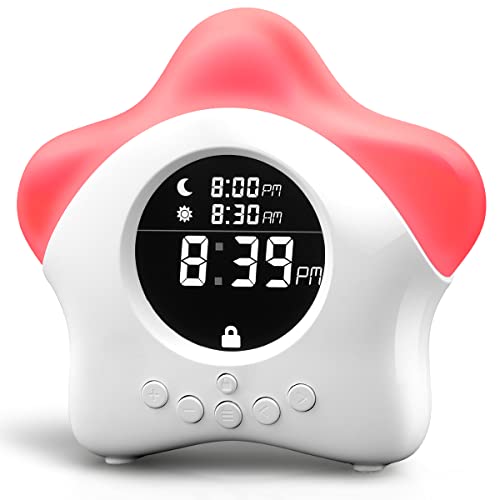
The Stay-in-Bed Clock for Kids – Toddler Sleep Trainer, Night Light & Alarm works best for parents guiding toddlers through independent sleep using visual cues, since color-coded red, yellow, and green LED lights clearly signal sleep time, wind-down periods, and when it’s okay to get up. I’ve found its 5-inch metal and ABS plastic design sturdy, with USB power and battery backup to keep settings during outages. It includes a nightlight, nap timer, and adjustable speaker, plus a storybook and 8-week reward chart to support routines. At 4.4 stars from over 2,700 reviews, it’s a trusted option, though it’s for indoor tabletop use only.
Best For: Parents helping toddlers learn independent sleep with visual cues and structured routines.
Pros:
- Color-coded red, yellow, and green LED lights effectively teach sleep and wake times
- Includes helpful accessories like a storybook, reward chart, and sleep training tips
- Battery backup and USB power ensure settings are preserved during power outages
Cons:
- Tabletop use only, not wall-mountable
- Battery not included despite backup support
- Limited to indoor use, reducing placement flexibility
LittleHippo Mella Kids Alarm Clock (Arctic Blue)
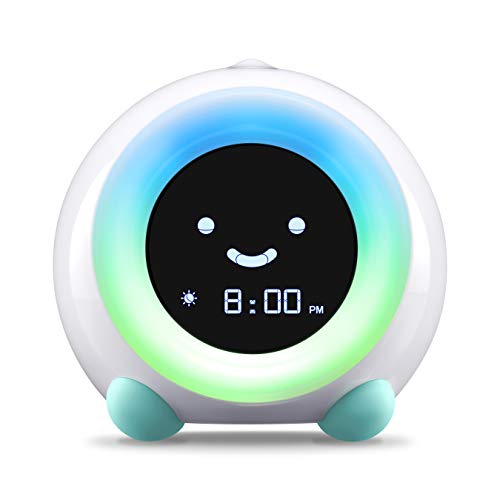
I trust the LittleHippo Mella Kids Alarm Clock (Arctic Blue) to guide my toddler through smooth sleep shifts, thanks to its intuitive color cues and expressive face that act like a gentle coach for little ones learning when to stay in bed and when it’s okay to get up. It eases shifts with a yellow glow 30 minutes before wake time, shifting to green at wake-up. I appreciate the three soothing sounds, five night light colors, and silent countdown mode for routines. Built from child-safe ABS plastic and silicone, it’s durable, compact, and meets FCC, CE, and CPSIA standards. It’s plug-powered, with a battery backup, and comes with a 1-year warranty and 100% satisfaction guarantee.
Best For: Parents seeking a reliable, intuitive sleep trainer to help toddlers and young children understand when it’s time to sleep and when it’s okay to wake up.
Pros:
- Uses color cues and expressive faces to gently teach children sleep and wake times
- Offers multiple soothing sounds, night light colors, and a silent countdown mode for routines
- Durable, child-safe design with global safety certifications and a 1-year warranty
Cons:
- Requires AC power with no battery-only operation, limiting portability
- Backup battery is a non-rechargeable lithium metal type, not user-friendly for long-term use
- Some users may find the alarm sounds limited in customization options
Ready to Rise Sleep Trainer (5th Gen)
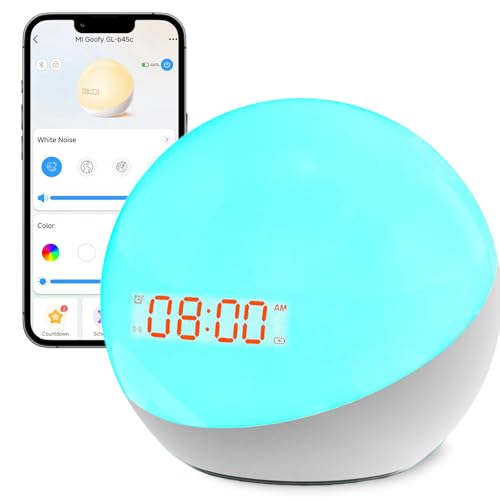
You’ll find the Ready to Rise Sleep Trainer (5th Gen) especially helpful if you’re guiding a toddler toward better sleep routines with consistent visual and auditory cues. I use its color and sound programming to mark sleep and wake times, helping my child understand when to stay in bed. The night light offers countless soft hues, comforting my little one during nighttime feeds. Made from child-safe materials and certified by FCC, CE, RoHS, and CPC, it feels secure to use daily. It doubles as a wake-up light and activity timer, growing with my child. I appreciate the 2-year warranty-it shows the company stands behind its quality.
Best For: Parents seeking a reliable, multi-functional sleep trainer to help toddlers and young children develop healthy sleep habits with visual and auditory cues.
Pros:
- Customizable color and sound programming effectively teaches sleep and wake times
- Durable, child-safe construction with multiple international safety certifications
- Versatile 2-in-1 function as a sleep trainer and night light with a 2-year warranty
Cons:
- May be too advanced for infants not yet responsive to visual cues
- Requires initial setup and programming for optimal routine reinforcement
- Limited functionality for children who wake frequently during sleep phases
Dreamegg Sound Machine Baby With Night Light

Who wouldn’t want a sleep solution that grows with their child while supporting consistent bedtime habits? I’ve found the Dreamegg Sound Machine Baby With Night Light does just that. It offers 34 soothing sounds-nature, ambient, white noise, and melodies-to ease my child into sleep. The customizable night light has solid, sunlight, and dynamic modes, including color fading and breathing effects, perfect for calming sleep cues. I control sounds, light, timers, and the okay-to-wake alarm through a simple app, even remotely. It’s portable, supports independent sleep during travel, and helps build long-term routines-ideal for nurseries or shifting sleep environments.
Best For: Parents seeking a versatile, app-controlled sleep solution that adapts to their child’s evolving sleep needs at home or on the go.
Pros:
- Offers 34 soothing sounds and multiple night light modes to create a customizable, calming sleep environment
- Remote app control enables easy management of sleep routines, timers, alarms, and settings from anywhere
- Portable design supports consistent sleep habits during travel and throughout a child’s development
Cons:
- App dependency may be inconvenient for users preferring manual controls or experiencing connectivity issues
- Higher price point compared to basic sound machines without smart features
- Dynamic light modes may be too stimulating for children sensitive to changing lights
Kids Dinosaur Sleep Training Alarm Clock
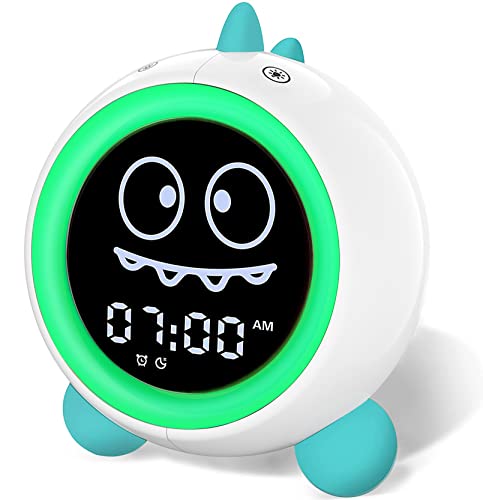
A colorful dinosaur with a friendly face doubles as a reliable bedtime guide for toddlers struggling with early wake-ups or inconsistent sleep routines. I use its color signals and facial expressions to show my child when to stay in bed and when it’s okay to rise, which helps her sleep through the night. The 9 colored night lights and adjustable brightness let me create a calming atmosphere, while 17 sounds-like white noise and lullabies-mask disruptive noises. It has a nap timer, snooze, and child lock, plus a dimmable display. Made from soft silicone and ABS plastic, it’s safe and durable, backed by a 1-year warranty.
Best For: Toddlers and young children who struggle with early wake-ups or inconsistent sleep routines and need visual cues to understand bedtime and wake-up time.
Pros:
- Uses color signals and facial expressions to effectively teach toddlers when to stay in bed and when it’s time to wake up
- Offers 9 colored night lights, 5 white light brightness levels, and 17 soothing sounds to create a calming sleep environment
- Durable, child-safe design with soft silicone and ABS plastic, compliant with FCC, CE, and RoHS standards
Cons:
- Must be plugged in at all times, limiting placement options in the bedroom
- Some features may be too advanced for very young toddlers to understand without consistent parental guidance
- Limited nap timer range (up to 120 minutes), which may not suit longer naps for older children
iHoo Ok to Wake Kids Alarm Clock

The iHoo Ok to Wake Kids Alarm Clock stands out for families guiding children ages 2 to 10 through consistent sleep routines using visual cues. It uses color signals-green with a smile for wake time, red with a sleep emoji for bedtime-automatically shifting based on preset times. The dual alarm supports flexible schedules, while a one-touch countdown timer helps manage naps or homework in 15- to 120-minute intervals. A touch-activated night light offers 7 colors and 3 warm brightness levels. With 4 soothing sounds, adjustable volume, and a snooze button, it adapts to individual needs. Made from safe ABS and silicone, it’s FCC, CE, ROHS, and CPC certified.
Best For: Families with children ages 2 to 10 who want to establish consistent sleep routines using visual cues and gentle audio guidance.
Pros:
- Uses intuitive color signals and emojis to teach time awareness and reinforce bedtime/wake-time routines
- Features a customizable countdown timer and dual alarm system to support structured daily schedules
- Includes a touch-activated night light with multiple color and brightness options plus soothing sounds for comfort
Cons:
- Corded design limits placement options and may require proximity to an outlet
- Limited to preset timer intervals (15, 30, 60, 90, 120 minutes), offering less flexibility for custom durations
- Smaller size and simplistic interface may not engage older children beyond age 10
OK to Wake Clock for Kids (Blue)
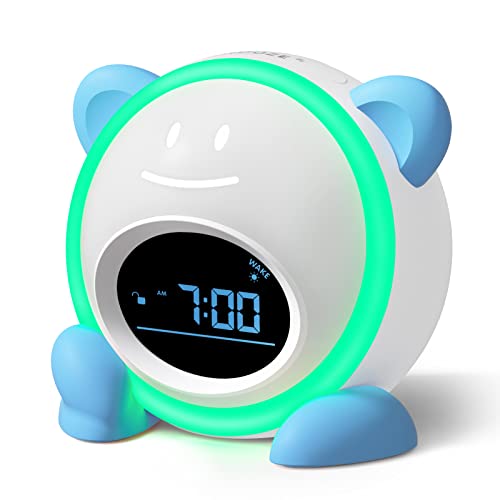
Wondering when your child will stop resisting bedtime or need constant reassurance about when to wake? I’ve found the OK to Wake Clock for Kids (Blue) helps by using clear facial expressions and color-coded lights to signal sleep, optional play, and wake times, making routines easier to understand. It works as an alarm clock, nap timer, night light, and sound machine, all in one. The built-in child lock needs a long press to adjust, so little hands won’t change settings. Even during power outages, the internal battery backup keeps your settings safe.
Best For: Families with young children who need visual cues to understand sleep, play, and wake times and benefit from a consistent daily routine.
Pros:
- Uses expressive facial features and color-coded lights to clearly communicate sleep, play, and wake times to kids
- Combines alarm clock, nap timer, night light, and sound machine for multifunctional use
- Includes child lock and battery backup to maintain settings during power outages
Cons:
- May be too advanced or distracting for very young infants who don’t yet understand time
- Limited color customization or facial expression options beyond preset modes
- Sound machine offers basic audio selections compared to dedicated white noise machines
iHoo Sleep Training Clock for Toddlers

Need a sleep aid that helps your toddler grasp the difference between wake time and sleep time without constant supervision? I’ve found the iHoo Sleep Training Clock simplifies this using sun and moon visuals with green and red lights to signal wake and sleep. It works well for kids 2–9, offering a 9-color night light and three levels of warm lighting that dim automatically. Six soothing sounds, like ocean waves or heartbeat, play for 30 to 120 minutes or all night. Dual alarms, a nap timer, and a 9-minute snooze help maintain routine. Touch controls and a child lock prevent accidental changes. It includes a backlit display, charges easily, and comes with a 12-month warranty-making it a reliable, giftable option for consistent sleep training.
Best For: Families with toddlers aged 2–9 who need help understanding sleep and wake times through visual cues and consistent routines.
Pros:
- Visual sun and moon indicators with color-coded lights (green for wake, red for sleep) help toddlers learn when to stay in bed or get up
- Offers customizable 9-color night light, 3-level warm lighting with auto-dimming, and 6 soothing sounds with adjustable timers for better sleep
- Features dual alarms, nap timer, 9-minute snooze, touch controls, and child lock for easy parental control and consistent sleep training
Cons:
- No differentiation between weekday and weekend wake-up times, limiting schedule flexibility
- Lacks smart features like app connectivity or voice control for advanced automation
- Charging cord and charger included, but battery life details are not specified for portability
Factors to Consider When Choosing a Baby Sleep Training Clock
You’ll want to check the light color options, since softer hues like red or amber can support better sleep by minimizing nighttime stimulation. Look at the sound variety and quality, as soothing sounds or white noise may help your baby relax, but poorly recorded tracks could disrupt sleep instead. Make sure the clock is easy to use, has a reliable power source, and carries safety certifications so you can trust its performance night after night.
Light Color Options
How do you choose the right light colors when picking a sleep training clock for your baby? Look for models that use red, yellow, and green cues: red for sleep, yellow for shift, and green for wake time. These signals help your child understand their schedule without words. Many clocks offer up to 10 customizable night light colors, letting you pick soothing tones for bedtime. Brightness usually adjusts across 3 to 5 levels, so you can dim the light enough to avoid disruptions but keep it visible. Color shifts between modes happen gradually, reducing confusion and supporting smooth shifts. LEDs provide soft, warm or cool light that won’t blind or overstimulate, reinforcing natural sleep-wake cycles. The right balance of color and brightness gives comfort while guiding your baby’s internal clock-helping build healthy sleep patterns over time.
Sound Variety And Quality
A well-designed sleep training clock pairs visual cues with thoughtful audio features to support your baby’s sleep routine. You’ll want a model with a wide variety of built-in sounds-white noise, nature sounds, lullabies, and ambient melodies-since different children respond better to certain audio types. High-quality audio matters too; clear, distortion-free playback keeps sounds soothing and prevents sudden noises that could disrupt sleep. Look for adjustable volume with at least nine settings so you can tailor sound levels to your room size and your child’s sensitivity. Many clocks offer sound timers, automatically shutting off after 30, 60, or 120 minutes to encourage quiet after sleep onset. If your child needs comfort all night, choose one with continuous playback. These features work together to support consistent sleep patterns without overwhelming your baby’s senses.
Ease Of Use
While maneuvering nighttime routines, you’ll find that a sleep training clock with simple controls makes all the difference. You want intuitive buttons or touch controls that let you adjust settings fast, without fumbling in the dark. Clear visual displays and straightforward menus help you navigate options easily, even when you’re tired. If the clock connects to an app, make sure the setup is simple and the interface is user-friendly, so you’re not stuck troubleshooting. Look for a child lock feature-it keeps little hands from changing settings but still lets you access controls quickly. Choose a model that saves your preferences and restores them after a power outage, so you don’t have to reset everything. These details add up, letting you focus on your baby’s sleep without frustration. A well-designed clock supports your routine, not the other way around.
Power Source Reliability
A reliable power source keeps your baby’s sleep training on track without unexpected disruptions. If you choose a corded electric model, you get steady operation without worrying about battery life. But if the power goes out, clocks without backup might lose settings, breaking your child’s routine. Look for models with internal rechargeable batteries or backup battery support-they’ll keep time and alarms accurate even during outages. Some units run only on AC power, so unplugging or electrical issues stop them completely. That kind of interruption can confuse your baby, weakening the consistency of sleep cues. Devices that maintain settings help preserve visual and auditory signals, which are key for reliable training. Consider how often your area has power issues and whether a backup-ready clock fits your needs. It’s a small feature that can make a real difference in keeping your baby’s sleep schedule stable.
Safety Certifications
Power interruptions can disrupt your baby’s routine, but even more important is ensuring the device you rely on meets strict safety standards. Look for baby sleep training clocks with certifications like FCC, CE, RoHS, CPC, CA65, and REACH, which confirm compliance with limits on electromagnetic emissions and harmful chemicals. Choose models tested under the CPSIA to avoid lead, phthalates, and other toxic substances. Devices made from non-toxic, child-safe materials such as ABS plastic and silicone reduce risks of chemical exposure or choking. Enclosed wiring protects against electric shock, while third-party testing verifies safety in electrical, mechanical, and thermal performance. Always check for clear certification labels-avoid uncertified products, as they may skip regulated safety steps meant to protect infants. A certified clock gives you confidence it’s built to safeguard your child while supporting consistent, restful sleep habits.
Frequently Asked Questions
Can These Clocks Help With Nap Training Too?
Yes, you can use these clocks for nap training too. They give clear visual cues that help your child recognize when it’s time to rest or wake up. Most models include adjustable lights and timers you can set for naps. Their consistent signals support daytime sleep routines just like nighttime ones. Many come with trial periods, so you can test if the features work well for your child’s nap schedule before fully committing.
Do Any Require Wi-Fi to Function Properly?
No, most baby sleep training clocks don’t require Wi-Fi to function properly. You’ll still get reliable visual cues, sound features, and timer settings without a connection. Some models offer Wi-Fi for app control or remote adjustments, but those are extras. If you prefer simplicity or have spotty internet, stick with non-Wi-Fi versions. They’re often more affordable and just as effective for consistent sleep routines. Check warranty details and trial periods to test what works best at home.
Are Replacement Parts Available for Broken Clocks?
Yes, you can usually get replacement parts for broken clocks, depending on the brand and model. Manufacturers like Hatch and LittleHippo often offer battery replacements, charging cables, or faceplates directly through customer service. Some models are modular, so you won’t need to replace the whole unit. Check warranty terms-many cover defects within a year. Keep receipts and register your product, as this speeds up support. Third-party sellers may also carry compatible components, but verify fit before buying.
Can I Customize the Alarm Sounds on All Models?
You can’t customize alarm sounds on all models-some let you choose from built-in options like lullabies or nature sounds, while others only offer basic beeps. Check the model’s specs to see what’s adjustable. Higher-end versions usually support personalized audio, but simpler ones don’t. If sound flexibility matters, pick a clock with multiple tone settings and test it during the trial period to verify it works well for your child’s routine.
Are They Safe for Newborns Under 6 Months?
Yes, you can safely use these clocks with newborns under 6 months. They’re designed with soft, non-distracting light levels and shatterproof materials to avoid hazards. Since they don’t emit harmful radiation or loud, sudden noises, they won’t disrupt your baby’s delicate sleep patterns. Most models offer dimming options and nightlight settings you can adjust as needed. Always place them out of reach and follow manufacturer safety guidelines.