Best Alarm Clocks That Guarantee You’ll Wake Up on Time
You’ll wake more reliably with alarm clocks combining light, sound, and vibration. Models like the DreamSky and ANJANK include adjustable sunrise simulation, loud alarms up to 112dB, and bed shakers with multiple intensity levels-ideal for heavy sleepers. Many offer gradual brightness, 20+ soothing sounds, and backup power to keep settings after outages. Some feature USB charging, customizable nightlights, and multi-alarm scheduling. Consider your sleep environment and sensitivity when choosing a blend of features. There’s more to explore about matching tech to your routine.
We are supported by our audience. When you purchase through links on our site, we may earn an affiliate commission, at no extra cost for you. Learn more. Last update on 20th July 2026 / Images from Amazon Product Advertising API.
Notable Insights
- Sunrise simulation with gradual light brightening over 10–30 minutes helps mimic natural waking and improves alertness.
- Extra-loud alarms up to 112dB paired with vibrating bed shakers ensure wake-up even for heavy sleepers.
- Multi-sensory alarms combine light, sound, and vibration for reliable awakening, especially for those with hearing challenges.
- Rechargeable battery backup preserves settings during outages and maintains alarm accuracy without power.
- Customizable alarms with gradual volume increase and 20+ soothing sounds support consistent, personalized wake-up routines.
Wake Up Light Sunrise Alarm Clock

Who wouldn’t want to wake up feeling more refreshed, especially if you’re a heavy sleeper or parent of a child who dreads the jolt of a blaring alarm? I’ve found this Wake Up Light sunrise alarm clock makes mornings easier by simulating a natural sunrise, brightening gradually over 30 minutes-though I can adjust that to 20 or 10. It offers 7 soothing sounds, like birdsong or ocean waves, with volume I can set in 16 steps. Two separate alarms let my partner and I wake at different times, each customizable for weekdays or weekends. The 9-minute snooze helps, and with 7 colored lights and 20 brightness levels, I use it as a calming nightlight.
Best For: Heavy sleepers, parents, and children seeking a gentler, more natural wake-up experience with customizable light and sound settings.
Pros:
- Sunrise simulation with adjustable duration and 7 natural alarm sounds promotes easier, more gentle waking
- Dual independent alarms with flexible scheduling (Every Day, Weekday, Weekend) suit multiple users or varying routines
- Multi-functional lighting with 7 colors, 20 brightness levels, and nightlight mode enhances usability beyond waking
Cons:
- FM radio requires manual tuning and may have limited reception in some areas
- LED display brightness options don’t include full customization for all lighting modes
- 9-minute snooze interval may be too short for users preferring longer rest periods
DreamSky Vibrating Alarm Clock for Heavy Sleepers
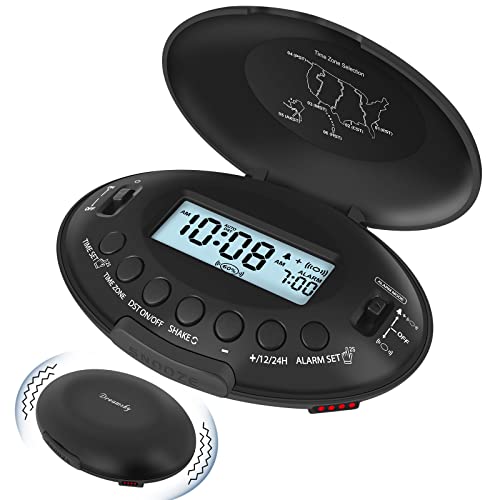
I rely on strong wake-up cues, and if you’re a heavy sleeper or have hearing challenges, the DreamSky Vibrating Alarm Clock offers a practical solution. It delivers adjustable vibration levels from 20% to 100%, with options for vibration-only or combined beeping. I place it under my pillow or mattress securely using the included tether, and its wireless design means no loose cords. The rechargeable battery lasts long, shows charge level, and alerts me when low. It auto-sets time and adjusts for daylight saving. I appreciate the 9-minute snooze and shake-off feature. It’s reliable for travel and makes a thoughtful gift.
Best For: Heavy sleepers, individuals with hearing impairments, and frequent travelers needing a reliable, portable wake-up solution.
Pros:
- Adjustable vibration intensities and dual alarm modes (vibration-only or vibration with beeping) suit a range of sleep needs
- Rechargeable battery with power indication and long-lasting performance enhances convenience and reliability
- Compact, wireless design with secure tether and auto DST adjustment makes it ideal for home use and travel
Cons:
- Vibration may not be strong enough for extremely deep sleepers at lower intensity settings
- LCD backlight only activates briefly, which may limit nighttime visibility
- No built-in battery backup in case of power loss during charging
Ok to Wake Kids Alarm Clock

What if your child could understand exactly when it’s time to rise without needing to read a clock? I’ve found the Ok to Wake Kids Alarm Clock simplifies mornings using red and green light signals-red means stay in bed, green means it’s okay to get up. It supports sleep training by creating a clear visual routine. The customizable night light offers ten colors and five brightness levels, easing shifts from day to night. Buttons sit right on the face, making setup easy, and it remembers settings after power loss. It must stay plugged in, but that guarantees reliability. Durable, kid-friendly, and gift-ready, it’s built to last.
Best For: Parents looking to establish a consistent sleep routine for toddlers and young children who benefit from visual cues.
Pros:
- Uses intuitive red and green light signals to teach children when to stay in bed and when it’s okay to get up
- Offers customizable night light with 10 colors and 5 brightness levels for a calming bedtime environment
- Easy-to-use design with face-mounted buttons, memory retention after power loss, and simple programming
Cons:
- Must remain plugged in during use, limiting placement options
- Does not include battery backup for power outages
- Color and brightness settings may be overwhelming for some children if not managed consistently
Housbay Wooden Sound Machine Alarm Clock

The Housbay Wooden Sound Machine Alarm Clock is a solid choice for anyone seeking a clutter-free, calming bedtime routine with subtle style. I appreciate its compact wood grain design, which blends into nightstand spaces without drawing attention. It offers 24 soothing sounds, like ocean waves and white noise, that mask disruptive background noises, helping me fall asleep faster. The gradual alarm increases gently with nature sounds, starting two minutes before the set time. I need to set it at least three minutes ahead for it to work properly. A one-touch button starts sleep mode, supporting a phone-free wind-down. Its dim nightlight provides soft visibility without disrupting sleep.
Best For: Individuals seeking a minimalist, stylish sleep aid that combines a gentle wake-up experience with noise-masking capabilities for improved sleep quality.
Pros:
- Compact wooden design seamlessly fits into bedroom decor and saves nightstand space
- 24 soothing sound options effectively mask ambient noise, promoting faster sleep onset
- Gradual alarm with nature sounds and one-touch sleep mode support a calming, phone-free routine
Cons:
- Alarm requires a minimum 3-minute advance setting to function properly, which may confuse some users
- Plug-in power design limits placement flexibility compared to battery-operated models
- Dim nightlight, while sleep-friendly, may be too faint for users needing clearer visibility at night
ANJANK Extra Loud Alarm Clock with Bed Shaker

Built for heavy sleepers and those with hearing challenges, the ANJANK Extra Loud Alarm Clock with Bed Shaker delivers a reliable wake-up experience through layered alerts. I rely on its 112dB front-facing speaker, 10 volume levels, and eight alarm sounds-from piano to sharp tones-to wake effectively. The wireless bed shaker, with a 32.8-foot range and three vibration intensities, runs up to three months per 1500mAh charge. I appreciate the USB-C and magnetic charging options. Its RGB display and 9-color night light offer adjustable brightness for comfort. While it needs constant power-no backup battery-I find its dual alarms and device-charging port practical for nightly use.
Best For: Heavy sleepers, individuals with hearing impairments, and students or elderly users needing a reliable, multi-sensory wake-up experience.
Pros:
- Features an extra loud 112dB alarm with 10 volume levels and 8 sound options for effective waking
- Includes a long-lasting wireless bed shaker with 3 vibration levels and up to 3 months of battery life
- Offers versatile lighting with RGB display, 9-color night light, and USB-C port for charging devices overnight
Cons:
- No battery backup for the main clock, requiring continuous power to function
- Bed shaker requires a nonstandard battery and separate charging setup
- Limited to indoor use with no advanced connectivity like Wi-Fi or app control
REACHER Wood Grain Sunrise Alarm Clock
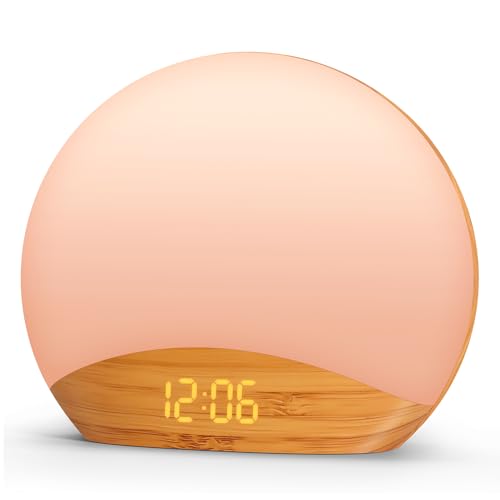
If you’re looking for a gentle way to start the day without the shock of a blaring alarm, the REACHER Wood Grain Sunrise Alarm Clock offers a natural wake-up experience by simulating sunrise with a gradual light increase over 5 to 60 minutes. I appreciate how the 26 sleep sounds-like rain, ocean waves, and white noise-help quiet distractions, running 5 to 180 minutes before shutting off. Its dimmable display and eight soft-color nightlight settings are easy on the eyes, especially at night. The wood-grain design fits neatly into any room, and the intuitive buttons let me adjust settings quickly. Even during outages, the built-in backup battery keeps my settings safe.
Best For: People who want a gentle, natural wake-up experience with customizable light and sound settings for improved sleep and morning routines.
Pros:
- Simulates sunrise with a gradual 5–60 minute brightness increase for a peaceful wake-up
- Offers 26 sleep sounds with adjustable timers to promote restful sleep
- Features a dimmable display and 8-color nightlight with a stylish wood-grain design
Cons:
- Requires an LR44 battery for backup, which may need periodic replacement
- Sound and light customization may have a learning curve for first-time users
- Limited brightness intensity compared to dedicated daylight therapy lamps
Clocky Alarm Clock on Wheels (Black)
When heavy sleepers need an alarm clock that won’t let them hit snooze and go back to bed, Clocky Alarm Clock on Wheels stands out by moving erratically across the floor the moment the alarm sounds, forcing you to get up and find it. I rely on its loud alarm and no-snooze design to disrupt deep sleep effectively. Its small, oval plastic body-measuring 3.5W x 3.5H inches-runs on 4 AAA batteries and rolls away when triggered. Built by CLOCKY (model CLKYb), it’s lightweight, easy to use, and works indoors. It’s backed by a limited warranty, has an ASIN of B004MSMUGI, and averages 4.0 stars from thousands of users.
Best For: Heavy sleepers and anyone who struggles with waking up on time and needs a fun, interactive way to get out of bed.
Pros:
- Unique moving design forces users to get out of bed to turn off the alarm
- Loud alarm and no-snooze option help improve wake-up success
- Compact, portable, and battery-powered for easy use at home or while traveling
Cons:
- Lightweight build may feel less durable over time
- Requires 4 AAA batteries (not included), increasing initial setup cost
- May not be effective on very large or cluttered rooms where it can get stuck
Vivilumens Sunrise Alarm Clock with White Noise
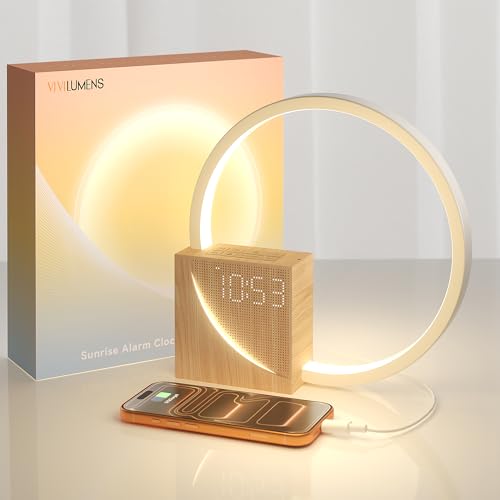
Who wouldn’t want to wake up feeling refreshed without the jolt of a blaring alarm? I’ve found the Vivilumens Sunrise Alarm Clock eases you awake with light that brightens gradually over 10 minutes, mimicking a natural sunrise. It’s designed for heavy sleepers, offering a gentle yet effective wake-up. The alarm sound grows slowly, with 12 volume levels and a 9-minute nap option. I appreciate the 10 white noise options, which fade out as the light dims at night. It has dual alarms, a dimmable touch lamp, and a wood grain finish that fits well in bedrooms. Powered by cord, it includes a USB port, runs on AC, and comes with a warranty.
Best For: Heavy sleepers and light-sensitive individuals who prefer a gentle wake-up experience with sunrise simulation and white noise features.
Pros:
- Gradual sunrise simulation and 12-level volume increase provide a natural, gentle wake-up
- Dual alarms and switchable 12/24-hour display support flexible sleep schedules
- 10 white noise options with fade-out timer enhance relaxation and sleep quality
Cons:
- Requires corded power only, no battery backup for portability or power outages
- Large 8.9-inch design may not fit in compact spaces
- Limited to one USB charging port despite modern multi-device needs
Cadmos Modern Curved Digital Alarm Clock (Pink)

What if your morning routine hinged not on a jarring buzz, but on a clock that blends visibility, gentle ambiance, and reliable function? I rely on the Cadmos Modern Curved Digital Alarm Clock in pink to deliver clear time reading with its large, 4-level brightness LED display and 8 dynamic RGB screen colors. Its 105 dB alarm has three volume levels, dual alarms, and a 10-minute snooze, helping me wake steadily. The built-in 7-color nightlight adds soft light, while the USB-powered unit includes battery backup to keep settings. It’s lightweight, plastic, and tabletop-ready for bedrooms or offices. I’ve got a one-item package with adapter, cord, manual, and a limited warranty-plus, over 2,700 reviews back its 4.4-star trust.
Best For: Those seeking a stylish, highly visible digital alarm clock with customizable lighting and reliable dual alarms for bedrooms, kids’ rooms, or offices.
Pros:
- Large, adjustable-brightness LED display with 8 dynamic RGB colors for clear visibility and ambient decor
- Dual alarms with 3-volume levels, 10-minute snooze, and battery backup to retain settings during outages
- Built-in 7-color nightlight and USB power with included adapter for convenience and charging
Cons:
- Plastic construction may feel less durable compared to higher-end materials
- 105 dB alarm, while loud, might be too intense for light sleepers at highest volume
- Limited mounting options, designed only for tabletop use
Reacher Digital Alarm Clock & White Noise Machine

Though compact, the Reacher Digital Alarm Clock & White Noise Machine packs a range of features that make it a solid pick if you’re looking to improve sleep consistency or manage mild insomnia with sound and light cues. I use its 21 soothing sounds-like rain, fan, or white noise-to wind down, and set one of seven gentle wake-up tones to rise naturally. The 8-color night light and dimmable display won’t disrupt my sleep, while the 9-minute snooze and memory backup keep routines steady, even during outages. At just under 14 ounces, it’s easy to move, and the 59-inch cord fits most outlets. I’ve found the 32 volume levels and sleep timers practical for long-term use.
Best For: People seeking a compact, feature-rich alarm clock with white noise and soothing sounds to improve sleep and establish a consistent wake-up routine.
Pros:
- Offers 21 soothing sounds and 7 wake-up tones for personalized sleep and wake experiences
- Features a dimmable display and 8-color night light that minimize sleep disruption
- Includes battery backup and memory function to retain settings during power outages
Cons:
- Limited to one alarm setting, which may not suit households with multiple users
- No battery operation, requiring constant access to an outlet despite backup
- Lacks smart features like Wi-Fi or app control for remote adjustments
Factors to Consider When Choosing an Alarm to Wake You Up
You’ll want to check the light brightness levels, since a gradual sunrise feature can ease you awake more naturally than a sudden flash. Consider the sound options variety and vibration intensity settings-having multiple alarms with flexible customization means you can tailor wake-up cues to your sleep patterns or any hearing preferences. And don’t overlook power backup availability, because losing your alarm during an outage could disrupt even the most consistent routine.
Light Brightness Levels
A well-chosen sunrise alarm clock typically offers brightness levels adjustable from 1% to 100%, letting the light rise gradually over 10 to 60 minutes to mimic a natural dawn. You can tailor the intensity to match your sensitivity, with some models providing up to 20 distinct levels for both the wake-up light and display. If you’re light-sensitive or share a room, lower settings help maintain sleep quality while still guiding your body awake. Many clocks let you turn the display brightness to “off,” ensuring total darkness when needed. Night light modes also offer soft, adjustable glow-usually at reduced levels-to avoid disrupting melatonin. You’ll want to test brightness during a trial period, if available, to find what works best for your sleep routine. Adjustable brightness gives you control, improving consistency whether you’re overcoming grogginess or managing irregular sleep patterns.
Sound Options Variety
Why do some alarms feel easier to wake up to than others? The variety of sound options plays a key role. You’ll want a clock with at least 7 to 10 distinct tones to avoid habituation, where your brain starts ignoring a repeated sound. Models offering 20 or more choices-like nature sounds, white noise, fan hums, or soft melodies-help you find what works best for waking up gently or easing into sleep. Adjustable volume across 10 to 32 levels lets you fine-tune loudness so it’s effective but not jarring. Many clocks also include sleep sound features with auto shut-off timers from 5 to 180 minutes, letting you enjoy calming audio without it running all night. Choosing the right sound variety improves both wake-up success and sleep quality.
Vibration Intensity Settings
While sound can be effective for many, vibration intensity matters just as much-especially if you’re a deep sleeper or have hearing difficulties. You’ll find most devices offer three to five intensity levels, letting you choose how strong the vibration feels. Higher settings penetrate deeper sleep, making them more reliable if you’re hard to wake. Lower levels provide a gentler start, which you might prefer if you’re sensitive or want a smoother wake-up. Adjustable intensity means you can test what works best over time, improving long-term consistency. Stronger vibrations also serve as a dependable cue if hearing loss makes sound less effective. Some alarms pair vibration with light or sound, increasing your chances of waking without startling you. Look for models with trial periods so you can test the vibration in your own sleep environment. Warranties often cover performance issues, giving you confidence in your choice.
Alarm Customization Flexibility
If you’re juggling different wake-up times throughout the week, look for alarms that let you set multiple independent timers, each customizable for specific days like weekdays, weekends, or daily repeats. You can adjust volume levels-some models offer up to 32 steps-to match your hearing or sensitivity. Choose from various sounds like nature clips, white noise, beeps, or melodies so your wake-up fits your mood. Many clocks include gradual alarms that increase volume or brightness over 10 to 60 minutes, easing you awake naturally. Snooze intervals are often around 9 minutes, but some let you customize this. Programming different alarms helps maintain consistency across shifting schedules. These features give you control over your mornings without overwhelming complexity. Test models with trial periods to see which fits your routine, and check warranty options for long-term reliability.
Power Backup Availability
You’ve set your ideal wake-up tone and fine-tuned your schedule, but what happens when the power flickers overnight? If your alarm clock lacks battery backup, you might wake up late-no power means lost settings and a silent morning. Many models use a CR2032 coin cell to keep time and alarms during outages, so you won’t need to reset them daily. That battery doesn’t run the clock display but saves your preferences. Some advanced clocks go further, with built-in rechargeable batteries that keep the whole system running without AC power. These offer more reliability, especially in storm-prone areas. Without any backup, a blackout could disrupt your entire routine. When choosing, check whether the model maintains memory only or operates fully off backup power. It’s a small feature that makes a real difference in consistency.
Frequently Asked Questions
How Do I Reset My Alarm Clock to Factory Settings?
You reset your alarm clock to factory settings by locating the reset button-usually a small pinhole on the back or bottom. Press and hold it with a paperclip for 10–15 seconds. Power cycles fully, restoring default options. Some models require unplugging first. Check the manual for model-specific steps. After resetting, reconfigure time, alarms, and preferences. This clears glitches, improves performance, and helps troubleshoot issues without affecting build quality or warranty coverage.
Can I Use the Bed Shaker Without the Sound Alarm?
Yes, you can use the bed shaker without the sound alarm-many models let you turn off audio alerts and rely solely on vibration. The shaker slips under your mattress and delivers strong, consistent pulses you feel but don’t hear, which helps light sleepers or those with hearing sensitivities. Most units offer adjustable intensity and duration. Check if your model has independent settings, so you can disable sound safely. Trial periods often let you test this feature risk-free.
Is the Sunrise Light Adjustable in Brightness and Color?
Yes, you can adjust the sunrise light’s brightness and color on most models. You pick a warm or cool tone that mimics natural daylight and set the brightness level to match your preference. These settings help ease your body awake more gently than a sudden beep. Some units let you save custom presets, so you don’t have to reset each day. Test different combos during the trial period to see what supports your sleep cycle best.
Does the Clock Lose Time if Unplugged for a Few Hours?
You lose time if you unplug most alarm clocks for a few hours, unless they have backup batteries. Without power, the internal clock resets, and you’ll need to set the time again. Models with battery backups keep time during outages. Check product specs for this feature-it’s common in digital clocks with rechargeable or CR2032 batteries. Look for one with retained memory and easy setup, especially if power loss happens often. Trial periods help test reliability.
Are Replacement Parts Available for the Vibrating Alarm Device?
Yes, you can get replacement parts for the vibrating alarm device-manufacturers often sell them directly or through authorized retailers. Check the model number and contact customer support to confirm availability. These devices usually have durable construction, but worn parts like cushions or straps are replaceable. A warranty might cover malfunctions, and some brands offer trial periods. Replacing components helps maintain performance without buying a new unit, saving money and extending use over time.